Lowkey: The Most Conscious Rapper Ever? A Deep Analysis of His Music, Activism, and Knowledge
An exploration of Lowkey’s dual identity as artist and activist, analyzing his lyrical consistency, public debates, and depth of political understanding.
In hip-hop, the label “conscious” is often used loosely for any artist who touches on social issues. But this has watered down the term’s real meaning. True conscious rap is more than just a theme; it’s a dedicated practice that consistently combines historical knowledge, political insight, and artistic skill to challenge the status quo.
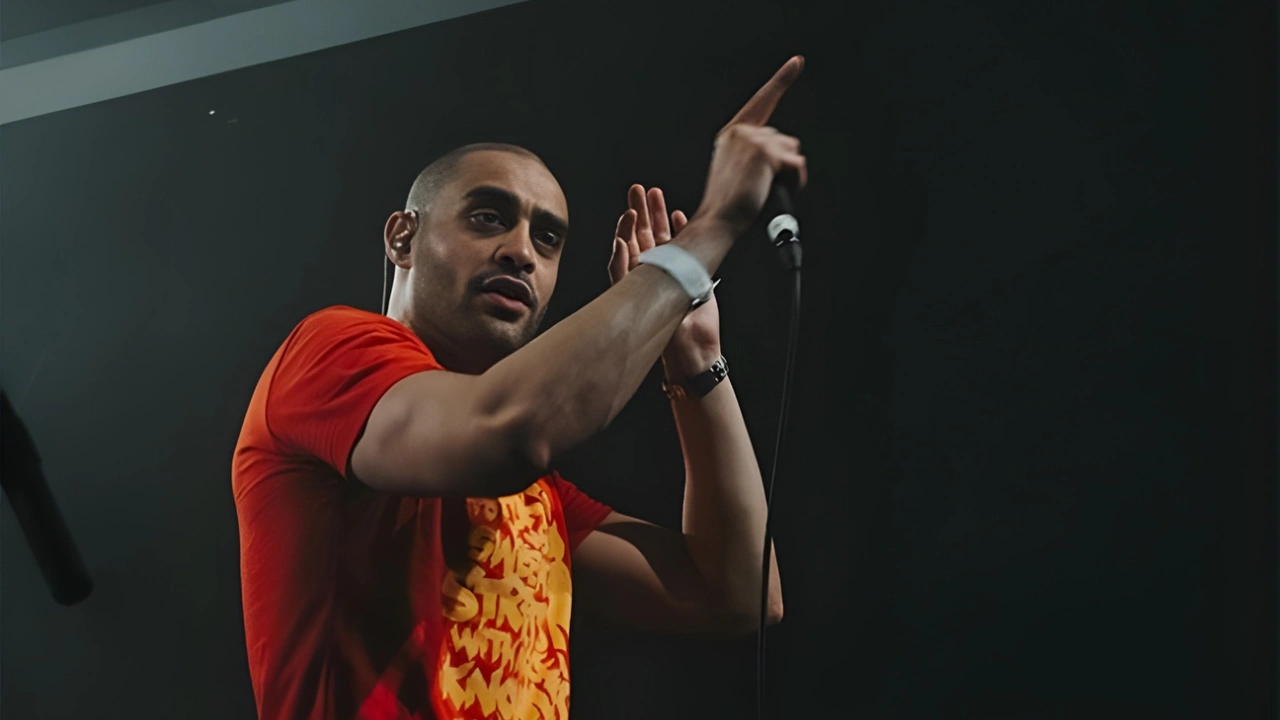
The British-Iraqi rapper and activist Lowkey has built his career on a powerful premise: that hip-hop can serve as both political theory and a moral record. His work goes beyond merely referencing injustice; it documents it, naming names and citing dates.
Lowkey’s credibility extends far beyond the music. He has debated at the Oxford Union, appeared on international networks like TRT World, and engaged in serious dialogues with thinkers such as Slavoj Žižek and journalists like Piers Morgan, whom he famously “corrected” on air. These appearances reveal an artist who moves fluently between the cultural and intellectual spheres, wielding the microphone as a tool on multiple fronts of the same struggle. As he told Al Jazeera, his music is a means “to denounce the structures that oppress us, to question, to mobilize and to empower.”
This article investigates whether Lowkey deserves the title of “The Most Conscious Rapper Ever.” While we try to avoid superlatives, some careers achieve a level of consistency and intellectual depth too great to be ignored. This is not an attempt to build one artist up by tearing others down. This is in no way meant to degrade the immense contributions of other great rapper-activists, from OGs like KRS-One and 2Pac to modern giants like Kendrick Lamar and Killer Mike, or fellow English rapper Dave. Instead, this essay focuses on how Lowkey might possess a unique, rare combination of three characteristics that sets his body of work apart.
This article examines the claim through three analytical lenses:
- Consistency in Lyrical Critique: how his discography sustains a factual, anti-imperialist focus across decades;
- Activism as Practice: his presence in debates, campaigns, and on-the-ground movements; and
- Depth of Knowledge: the intellectual foundation that distinguishes his analysis from celebrity advocacy.
WATCH: LOWKEY – SOMETHING WONDERFUL (OFFICIAL VIDEO) | Uploaded on February 1, 2010, on GlobalFaction
1. Lowkey: Consistency in Lyrical Critique
Across nearly two decades of output, Lowkey’s lyrical universe has remained centered on systemic critique. From his early Key to the Game mixtapes (2003-2005) through Uncensored (2009) to his later releases, Soundtrack to the Struggle 3 (2024), his songs form an ongoing investigation into state power, militarism, and corporate complicity. Each track advances an argument using historical data, named actors, and direct appeals to accountability.
1.1 Deconstructing Imperial Mythology: The "Obama Nation" Trilogy
On the Obama Nation trilogy (2009–2011), equating “abomination” with the president’s name, Lowkey dismantles the notion that representation equals liberation: “Since 1945, the United States has attempted to overthrow more than 50 foreign governments.”
With this opening line, Lowkey anchors his critique in the post-WWII era, a period defined by the Cold War that led the U.S. to engage in numerous covert and overt operations, including funding opposition groups, assassination plots, and military invasions, aimed at replacing governments perceived as threats to its political and economic interests. The follow-up: “The American Dream only makes sense if you’re sleeping”
Here Lowkey argues that the idealized concept of prosperity and upward mobility is nothing more than a comforting illusion. The dream, which posits that anyone can achieve success through hard work, “makes sense if you’re sleeping” because only in a state of unconsciousness (or denial) can one ignore the harsh economic and systemic realities. This line possibly challenges the myth of meritocracy and suggests that for vast segments of the population, particularly those facing poverty and racial barriers, the dream is unattainable, a fiction used to pacify the masses.
Across all three installments of Obama Nation, Lowkey argues that a change in skin complexion does not equal a change in power. “It’s over people, wake up from your dream now, Nobel Peace Prize, Jay-Z on speed-dial, it’s the substance within not the color of your skin.”
Here, the rapper addresses the listeners directly, urging them to “wake up” from their dream, a continuation on the “American Dream” or a call to political awareness. He rejects the celebratory narrative around Barack Obama’s presidency, pairing the Nobel Prize and celebrity endorsement with the hollowness of image politics.
He also cites policy architects such as Zbigniew Brzezinski, Dennis Ross, and Robert Gates, “There was still Dennis Ross, Brzezinski and Robert Gates…”, demonstrating that the machinery of empire remains constant, regardless of who operates it. The line “White power with a black face” condenses this argument.
Over a decade later, in “No War” (2024), Lowkey raps: “But Sheikh Osama was Gates, Carter and Reagan’s partner, So we don’t rate Osama, neither do we rate Obama.” Here, the rapper draws a controversial historical connection to Osama bin Laden and uses that critique to dismiss two American Presidents. The bar argues that Sheikh Osama (bin Laden) was an operative who, at one point, aligned with U.S. interests, specifically naming Presidents (Jimmy) Carter and (Ronald) Reagan, along with (Robert) Gates.
This refers to the historical fact that during the Soviet-Afghan War (1979–1989), the U.S. provided significant funding and arms to the Afghan Mujahideen fighters (of which bin Laden was a part) to fight the Soviet invasion. The line alleges that American leaders effectively partnered with the man who would become their ultimate enemy, highlighting the cynical and contradictory nature of U.S. foreign policy.
This pattern is not merely historical; it finds a modern parallel in the trajectory of Ahmed al-Sharaa (Abu Mohammad al-Julani, founder of the Al-Nusra Front, an official Al-Qaeda affiliate), now the president of Syria, who is undergoing a transformation from a US-designated terrorist into a seemingly political actor.
The conclusion, “So we don’t rate Osama, neither do we rate Obama,” thus uses this historical and contemporary hypocrisy to justify a stance of radical non-alignment, dismissing all established political leaders as untrustworthy.
VIDEO: LOWKEY SPEECH, PALESTINE PROTEST, 12/06/2021 | Uploaded on July 26, 2021, on Migration Films
1.2 Language as a Battlefield: “Terrorist” and “No War”
Lowkey consistently engages in a defiant reclamation of the political lexicon. He challenges the very language of the powerful, exposing how terms like ‘terrorist’ are constructed not as descriptions, but as weapons to legitimize state violence and invalidate liberation struggles.
In the track “Terrorist” (2011), the chorus quotes the dictionary definition of terrorism and applies it consistently. If terrorism is “the systematic use of terror for political ends,” then the modern state, with its wars, embargoes, and drones fits that description. He raps in the same song: “What’s the bigger threat to human society, BAE Systems or home-made IEDs?”
By juxtaposing BAE Systems, one of the world’s largest arms manufacturers, which profits from institutionalized violence, with the improvised weapons of insurgents, Lowkey exposes the moral inversion of the War on Terror. The core critique is that while IEDs cause immediate, localized damage, the massive, state-sanctioned production and sale of sophisticated weaponry by corporations poses a “bigger threat” to human society.
A similar strategy drives “Long Live Palestine” (2011), where he confronts Israeli policy and Zionism directly: “Israel is a terror state, they’re terrorists that terrorize… This is not a war, it is systematic genocide.”
These are not rhetorical provocations. Calling Israel “a terror state” committing a “systematic genocide” extends the same definitional logic applied earlier to Western powers. This perspective is grounded in a detailed critique of Israel’s long-term military occupation, its settlement policy, and the large-scale military operations conducted in Palestinian territories, particularly in Gaza.
The song’s precision, “Not every Zionist is Jewish, and not every Jew is a Zionist” reveals intellectual discipline. This speaks to a significant portion of the global Jewish population who, while proud of their religious identity, are non-Zionist or even anti-Zionist. Some of these individuals oppose the political actions of the State of Israel and its treatment of Palestinians, maintaining that their faith is separate from the modern political movement. Lowkey separates ideology from faith, focusing the critique on policy rather than identity, allowing his advocacy to remain grounded in evidence.
the second verse of “No War” (2024), the critique widens to media and public psychology: “They call us paranoid Arab boys, But tabloids describe our killing in the passive voice.”
Here, Lowkey highlights the negative stereotype that labels Arab individuals as inherently suspicious or overly fearful, a projection often stemming from Western Islamophobia and the conflation of Arabs with terrorism. The passive voice minimizes agency and responsibility, often obscuring who is doing the killing.
The rapper suggests that when Arab people are killed, the media uses passive language to downplay the violence, sanitize the actions of the perpetrators and make the deaths seem like unfortunate, unassigned accidents rather than deliberate acts. This contrast exposes a double standard: Arabs are stereotyped with active, negative traits, yet their deaths are narrated with passive, minimizing language.
Have a look at this phrasing by Sky News (REAL EXAMPLE): “A stray bullet found its way into the van and killed a 3-year-old young lady”.
VIDEO: LOWKEY – No War (OFFICIAL MUSIC VIDEO) feat Styles P | Uploaded on Oct 31, 2024, on Double Down News
1.3 Global Solidarity: "Long Live Palestine" and “Vietnam”
Lowkey’s pro-Palestine work stands out for both its longevity and precision. The first iteration of “Long Live Palestine” was released in early 2009 during Israel’s Operation Cast Lead, a track born in direct response to a live crisis. He followed with Part 2 in 2010, assembling a global coalition of artists, and nearly a decade later, released Part 3 in 2019.
Beyond the trilogy, he keeps the momentum going with powerful standalone tracks, from 2023’s defiant “Palestine Will Never Die” to 2024’s hopeful “Houriya” (Ft. Harris J). This timeline demonstrates a commitment that spans over a decade, ensuring the issue remains in the public consciousness across different geopolitical moments.
In the lyric (Live Long Palestine, P.1): “Every coin is a bullet if you’re Marks and Spencer, when you’re sipping Coca-Cola, that’s another pistol in the holster of them soulless soldiers,” Lowkey reframes consumer choice as a form of direct participation in conflict. By naming specific corporations like Marks & Spencer and Coca-Cola, both prominent targets of the Boycott, Divestment, and Sanctions (BDS) movement due to their documented ties to the Israeli occupation , he moves beyond abstract critique to advocate for a concrete, actionable strategy.
The verse collapses the distance between the economic and the military, arguing that consumer spending directly finances the instruments of oppression, thereby transforming the act of purchasing into a critical ethical and political decision.
In “Long Live Palestine, P.2″ (2010), he deepens the critique by grounding it in historical specificity. He invokes the 1917 Balfour Declaration, the British imperial promise that laid the foundation for the state of Israel, and names the Rothschild family, long entangled in the mechanisms of empire: “Balfour was not a wise man, shame on Rothschild.”
The third installment, “Long Live Palestine P.3″ (2019), begins not with Lowkey’s voice but with a poem, “Think of Others” by the late Palestinian poet Mahmoud Darwish, read by Scottich comedian Frankie Boyle. Darwish’s lines: “As you wage your wars, think of others, Do not forget those who fight for peace” set a moral frame that fuses poetry, politics, and pedagogy. The poem’s refrain “think of others” turns remembrance into action, echoing the ethical foundations of Lowkey’s entire corpus: awareness must lead to solidarity.
As Lowkey declares: “This is for Palestine, Al-Quds, the capital Jerusalem, Unarmed people marching to the wall and they’re shooting ’em.” The opening verse reasserts a truth rarely acknowledged in mainstream Western narratives: that resistance in Gaza and the West Bank is, in large part, unarmed. The juxtaposition of “marching” and “shooting” condenses asymmetry into a single line, framing occupation as a moral question rather than a geopolitical abstraction.
Later in the track, Lowkey personalizes that continuity of struggle by invoking real figures of resistance: “If Ibrahim Abu Thuraya could resist without a wheelchair, Ten-year challenge, tell Regev we are still here.” The mention of Ibrahim Abu Thuraya, a Palestinian double amputee killed by Israeli fire during a protest, functions as a memorial, blurring the line between a song and a documentary.
Across all three parts of “Long Live Palestine,” Lowkey builds not a protest song but a tradition of counter-memory. The trilogy enacts what Darwish called the right to remember: a refusal to let the archive of dispossession be overwritten by imperial narratives. The recurring refrain, “Long live Palestine, long live Gaza” is thus a covenant, binding music to moral continuity.
That coherence endures more than a decade later on Soundtrack to the Struggle 3 (2024), particularly in “Vietnam” and “No War.” Both songs confirm that Lowkey’s method has not shifted but grown more potent.
In “Vietnam” (2024), he situates anti-colonial struggle within a global moral continuum: “I don’t know about you but all my heroes fought colonizers… I don’t know about you but all my heroes fought occupiers.” This refers to resistance movements against colonialism. The heroes invoked could include figures like Nelson Mandela (South Africa), Ho Chi Minh (Vietnam), Abdelkrim al-Khattabi (Morocco), Simon Bolivar (Venezuela), or countless others who fought for national liberation and self-determination.
This repetition in the hook emphasizes that the rapper’s moral compass values those who stand up against foreign dominance and imperialism, binding the Vietnamese struggle to Iraq, Palestine, and any site of occupation, positioning his own worldview as one of solidarity with the globally oppressed.
In the verses, he writes, “You lived a nightmare so their dreams are carefree,” a line that frames sacrifice as the foundation of modern comfort. Later, the voice of the imprisoned narrator declares: “I’m the bars you grip for comfort instead of loved ones… I also long to be free,”
turning solidarity into empathy. The song’s perspective oscillates between witness and participant, evoking both memorial and manifesto. “Vietnam” thus extends Lowkey’s long project: exposing how imperial violence depends on the erasure of those who resist it.
The same logic continues in “No War” (2024), his collaboration with Styles P, where the target shifts from history to immediacy. Lowkey opens with indictment: “The killers chilling in villas while militants pillage villages, Is it just the pigment they didn’t consider innocent?”
He links racial hierarchy to geopolitical violence, arguing that empathy itself is racialized. The verse proceeds through an investigative chain, from John Pilger’s suppressed journalism to the “weight of West-toxication,” indicting both media complicity and moral fatigue.
VIDEO: Lowkey – Long Live Palestine Ft. Frankie Boyle, Maverick Sabre (Part 3) [Music Video] | Uploaded on April 6, 2019, on GRM Daily
2. Lowkey: Beyond the Booth, Activism as Practice
Lowkey’s activism extends far beyond the recording studio. Over the last fifteen years, he has established himself as a consistent public intellectual and debater who engages directly with ideological opponents, scholars, and policymakers. His presence on major discussion platforms, ranging from Oxford Union and Piers Morgan Uncensored to TRT World and the Institute of Art and Ideas, discussing subjects ranging from empire and identity politics to Gaza crisis and surveillance capitalism.
These appearances, alongside philosophers, essayists, and policymakers, illustrate how he translates his political convictions into rigorous public discourse. Rather than confining activism to lyrics, he engages audiences in universities, media studios, and civic arenas, using each platform to advance critical discussion of power, justice, and accountability.
His real-world activism matches the intensity of his public discourse. Since the late 2000s, Lowkey has repeatedly participated in major protests, campaigns, and humanitarian drives. During the 2009 and 2014 Gaza bombardments, he performed at and addressed rallies organized by the Stop the War Coalition and the Palestine Solidarity Campaign, both of which later named him as a patron. In these settings he has acted not as a celebrity guest but as a committed organizer, speaking at demonstrations, fundraising for humanitarian relief, and amplifying boycott calls.
In 2017, he became a visible presence in the Vote Labour movement, campaigning for Jeremy Corbyn alongside artists such as Akala, JME, and Stormzy. His work focused on mobilizing young voters and addressing inequality through local events and digital campaigns. That same period saw him lend support to the Justice for Cleaners campaign at SOAS University, appearing on picket lines and linking wage justice to broader anti-austerity politics.
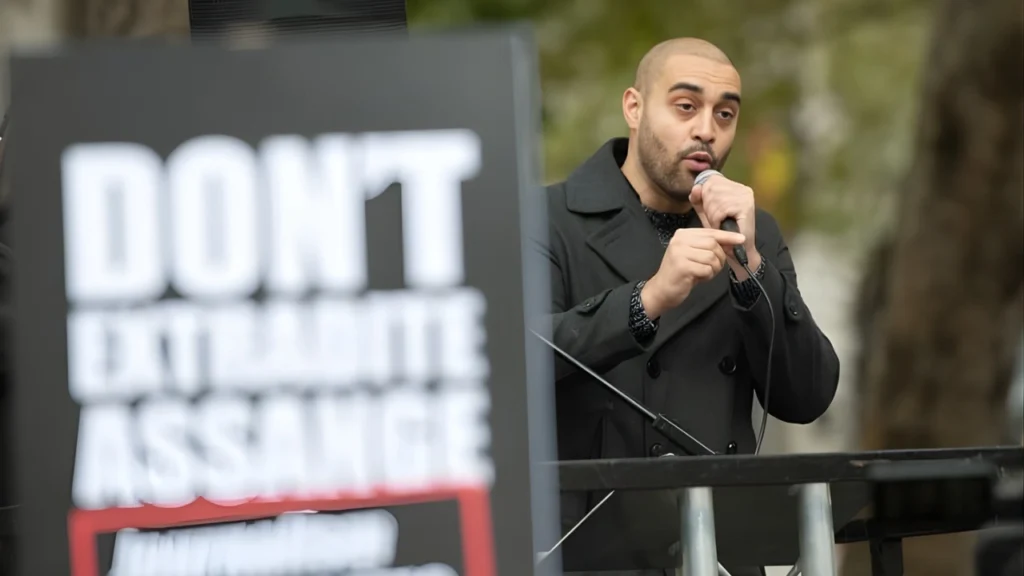
More recently, Lowkey’s activism has continued in tangible and digital forms. In 2024 and 2025, he spoke at multiple solidarity events, including “A Year of Resistance in the Face of Genocide” in Newcastle and rallies for Julian Assange in London. In September 2025, he performed in Belfast before joining BDS Belfast activists at court, publicly defending those charged with distributing boycott materials.
The political commitment evident in Lowkey’s music is neither metaphorical nor performative. It is embodied in the debates he attends, the alliances he forges, and the institutions he confronts.
VIDEO: Palestine Talks | British rapper and activist Lowkey unravels the UK’s Israel lobby | Uploaded Feb 2, 2024, on TRT World
3. Lowkey: The Depth of Knowledge
Lowkey’s public profile differs from that of most politically vocal rappers in one crucial respect: his engagement with historical, economic, and legal material is neither superficial nor derivative. Across his body of work, musical, journalistic, and intellectual, he demonstrates sustained familiarity with the structures and doctrines that underpin the global issues he critiques. His arguments are not borrowed talking points but synthesized analyses, drawn from study, reading, and public debate.
At the Oxford Union, one of the world’s oldest and most prestigious debating societies, Lowkey took part in “This House Believes the Arab World Has Failed the Palestinian People” (2019). Arguing against the motion alongside Dr. Ghada Karmi, Kito de Boer, and Imad-ad-Dean Ahmad, he situated the discussion within the historical context of Arab League policy, Western intervention, and the political constraints placed on regional governments by global powers. His appearance placed a recording artist in a setting usually reserved for academics and diplomats, reinforcing his reputation as a serious interlocutor in international political discourse.
His televised and digital interventions show a similar depth of preparation. On Piers Morgan Uncensored in 2023, in the segment titled “Piers Morgan vs Pro-Palestinian Rapper Lowkey on Israel–Hamas War,” he challenged the host’s framing of the conflict by citing international humanitarian law and UN Security Council resolutions. He referenced the Hannibal Directive, explaining its historical use and citing cases such as Hadar Goldin during Operation Protective Edge (2014) to illustrate systemic military policies that endanger civilians. Lowkey also drew on reports from Amnesty International, B’Tselem, and Human Rights Watch, all of which have formally classified Israel as an apartheid state. While many television guests rely on rhetorical provocation, Lowkey consistently grounds his arguments in verifiable documentation and primary sources.
This evidence-based approach also defines his investigative work. In the YouTube series “Epstein, Media Bias & Israeli Influence: Lowkey Investigates,” he examines the intersection of lobbying networks, corporate media ownership, and foreign policy narratives. He references publicly available records, such as financial filings and meeting logs, to trace how political elites and media figures shape discourse. In one episode, he quotes directly from the Israel Project’s 2009 Global Language Dictionary, a hasbara (public diplomacy of Israel) guide instructing communicators to frame Hamas as the root cause of Palestinian suffering. Lowkey contrasts that propaganda framework with conditions in the occupied West Bank, where no Hamas presence exists, yet Palestinians continue to lose homes and lives daily, underscoring the systematic nature of dispossession beyond partisan framing.
VIDEO: Piers Morgan vs. Pro-Palestinian Rapper Lowkey On Israel-Hamas War | The Full Interview | Uploaded on Oct 25, 2023, on Piers Morgan Uncensored
His appearances at the Institute of Art and Ideas display similar intellectual rigor. In “Oppression and Creativity” (2019), alongside Andrew Motion and Joanna Kavenna, he rejected the notion that repression produces artistic greatness. “The best-case scenario,” he explained, is that oppression makes repression and violence against dissenting thinkers more tolerable; the worst-case scenario is that their achievements are credited not to the creators themselves, but to the very powers that oppressed them. To illustrate, he invoked Galileo’s persecution by Pope Urban VIII, describing the absurd logic by which the Church could later claim that placing Galileo under house arrest somehow enabled his discoveries in physics. In this framing, oppression is not a catalyst for creativity but a mechanism that rewrites ownership of knowledge.
Three years later, in “Do We Hide Behind Identity Politics?” (2022) with Slavoj Žižek, Lowkey returned to the IAI stage, redirecting the discussion from abstract moralism to material critique. Quoting Žižek’s own ‘Against the Double Blackmail’ (2016), where the philosopher wrote that “refugees come from a culture that is incompatible with Western European notions of human rights,” Lowkey countered that such statements exemplify the very identity essentialism they claim to oppose.
In “Lowkey vs David Goodhart on British Empire” (2019), he demonstrated similar historical precision. Challenging Goodhart’s defense of British exceptionalism, Lowkey described the Empire as “an economic project,” emphasizing that its purpose was not civilizational uplift but the extraction of wealth, explaining that before the East India Company consolidated colonial control, Britain’s share of global GDP was roughly 1.8%, while India’s was about 23%. Through centuries of extraction and trade monopolies, that ratio reversed, Britain industrialized while India and China were systematically de-developed.
Lowkey’s commitment to research also extends to his London Circle lecture “The Tangled Web of Zionist Interests” (2024), where he opened with former Israeli military leader Moshe Dayan’s remark, “we need to find a way to make occupation invisible,”calling it the most illustrative description of the settler-colonial logic governing historical Palestine. He then examined the export of surveillance technologies developed in occupied territories to Western markets, naming firms such as NICE Systems and Cellebrite, and linking their operations to domestic policing and data extraction in the United Kingdom and beyond. He also detailed how the Israeli Ministry of Strategic Affairs coordinated disinformation and lobbying campaigns through private intelligence firms, citing budgetary records and open-source documents.
Conclusion: THE Activist, THE Rapper and THE Scholar
Measured against the criteria of lyrical consistency, tangible activism, and intellectual depth, Lowkey’s record stands as one of the most sustained examples of political consciousness in contemporary music. Across more than fifteen years of output, his discography forms not a sequence of isolated protest songs but a cumulative dossier of geopolitical critique. From “Long Live Palestine” (2009) and “Obama Nation” (2010) to “Vietnam” and “No War” (2024), his lyrics have maintained an unbroken focus on imperialism, corporate militarism, and state hypocrisy.
Outside the studio, his activism mirrors that intellectual consistency. Unlike artists who appear intermittently at rallies or tweet solidarity slogans, Lowkey has embedded himself in ongoing campaigns: the Stop the War Coalition, the Palestine Solidarity Campaign, and labour movements such as Justice for Cleaners. He has addressed crowds, marched with unions, and lent his profile to fundraising and boycott efforts. More unusually, he has entered arenas of structured debate, Oxford Union, Institute of Art and Ideas, and Piers Morgan Uncensored, where claims are challenged, not applauded.
The intellectual scaffolding behind that activism is equally distinct. Lowkey’s command of political theory, international law, and history, evident in his references to Articles of the UN Charter, the Sykes–Picot Agreement, or the deregulation policies that led to the Grenfell fire, signals a level of engagement uncommon among musicians. His ability to cite, contextualize, and apply such material in live debate and lyrical form bridges the gap between scholarship and street-level communication.
If “consciousness” in hip-hop traditionally denotes awareness of oppression and resistance, Lowkey extends that definition to intellectual labor and civic participation. While terms like “most” or “ever” remain subjective, the empirical evidence is compelling: few, if any, rappers have sustained such a coherent political thesis across multiple media and decades.
To engage with Lowkey is to study, not just to listen. His music demands annotation, fact-checking, and re-listening. That demand is not elitist; it is democratic. It insists that art can still teach us how to think critically, feel collectively, and act responsibly.
Therefore, whether or not one accepts the superlative, the factual record supports the argument that Lowkey occupies a singular position in global hip-hop. His music and activism operate as a continuous investigation into power, empire, and accountability. In that sense, the title “The Most Conscious Rapper Ever” functions less as exaggeration than as a fact-based description: a reflection of an artist whose entire career has been an act of analysis, a syllabus in rhyme for the politics of our time.
Written by:
Ben Tarki Moujahid
Author
 View all posts
A music critic and a researcher, Moujahid writes in-depth articles analyzing Moroccan and global hip-hop, blending insights from industry experts into compelling, well-rounded critiques. Beyond writing, he plays a pivotal role in shaping the magazine's editorial vision, refining its tone, structure, and style to elevate the reader's experience. As the lead editor, Moujahid meticulously oversees and polishes nearly all published articles, ensuring the magazine maintains its reputation as a trusted and influential voice in music journalism.