Between Two Worlds: French Montana’s Connection to Morocco
For French Montana (born Karim Kharbouch), the journey from the streets of Morocco’s biggest city, Casablanca, to the peak of the American hip-hop charts is more than a simple success story. He arrived in the U.S. speaking only Darija (Moroccan Arabic) and French, a fact his classmates often joked about by calling him “Bonjour” (hello in French), a nickname he would later embrace by adopting the moniker “Young French”. The “Montana” came later, after some began calling him “Montana” (a ref to Tony Montana), during his days dealing drugs, which Drake described as, “I had this idea of French in my head, like, this young untouchable mob boss from New York.”
While many artists gradually assimilate into the homogenizing world of US rap, Montana has spent his career building a bridge between the South Bronx and North Africa. He often reflects on this period by comparing the act of picking rap as a hobby without knowing the language to being “blind and wanting to paint like Michelangelo”. His eventual mastery of English through the streets and Bronx high schools was his first true act of cultural fusion, yet he never abandoned his heritage even at the height of Bronx street life.
The following explores how often French Montana weaves his Moroccan background into his interviews and music, and the methods he uses to do so.
VIDEO: The French Montana Story: For Khadija | Official Trailer | Paramount+ | Follow French Montana’s struggle and subsequent rise to become one of the most iconic rappers of a generation. by Paramount Plus
Montana’s Spirit: Navigating Fame Through a Muslim Lens
Montana’s identity is anchored by a strong commitment to his Muslim faith, a personal grounding he views as the true engine of his success. Raised a Sunni Muslim, he credits his faith with providing a moral compass, stating in a 2016 interview with XXL that his religion instills a “fear of not doing the right thing” and a guide to “doing positive”. He has even linked his faith to his physical survival, particularly after a 2003 incident where he was shot in the head just as his career began to gain momentum, a “miracle” that he views as a divine second chance.
This spiritual foundation manifests in a commitment to religious practice; he observes the fast during Ramadan and famously steps away from social media during the holy month to maintain spiritual focus. French also remains guided by family and community values: he has spoken about “God bless[ing] you to bless other people,” and often cites his early years in Africa when discussing his charitable acts and purpose.
Montana’s visibility as a Muslim artist in America is characterized by both overt and subtle markers. He frequently wears a necklace bearing the name “Allah” (God in Islam) in interviews and music videos like “Hard Life” (2024). He puts it best in his song “Casino Life 3” when he raps: “Life as a rap star is nothing without God” and later says “making salaat (prayer) in the sky, PJ facing the East” (a ref to the direction that Muslims face when praying).
VIDEO: French Montana – Casino Life ( Official Video ) | Montana pays tribute to his heritage by wearing the Moroccan national team jersey, while a chain inscribed with “Allah” reflects his Islamic faith.
Montana’s Hero: Khadija’s Twenty-Five Year Sacrifice
His 2024 documentary, The French Montana Story: For Khadija, executive produced by Drake, serves as a definitive archive of Montana’s connection to his mother, explicitly honoring her sacrifices and framing his entire career as an immigrant family’s collective journey. The film, which premiered at the Tribeca Film Festival in 2023 and hit Paramount+ in November 2024, reveals the harrowing reality of their arrival in the U.S.
Montana was born into a middle-class family in Casablanca, where his father, Abdellah, worked as a businessman dealing in gold. Encouraged by friends and clients based in the U.S. to pursue better opportunities, his father sold most of his properties, secured a ten-year visa, and moved the family to New York. After a few years and several failed business ventures, his father decided to return to Morocco. But his mother, Khadija, refused. Determined to give her children a better future, she took on the risk of raising three sons on her own, while working odd jobs, taking double shifts, and doing whatever she could with no English and no specialized skills. She held fast to the promise of the ‘American dream’.
The family overstayed their visas, which later cost Montana a college basketball scholarship as he mentioned in an interview. Most heartbreaking of all, due to her visa status, Khadija did not see her family in Morocco for 25 years. Montana frequently calls her the “real hero,” telling CBS News, “Those are the things you do for your child when you want a better future.” The journey came full circle only after Montana’s success allowed him to secure her a Green Card. Watching her finally reunite with her sister in Morocco, he has said, meant more to him than any platinum record or award.
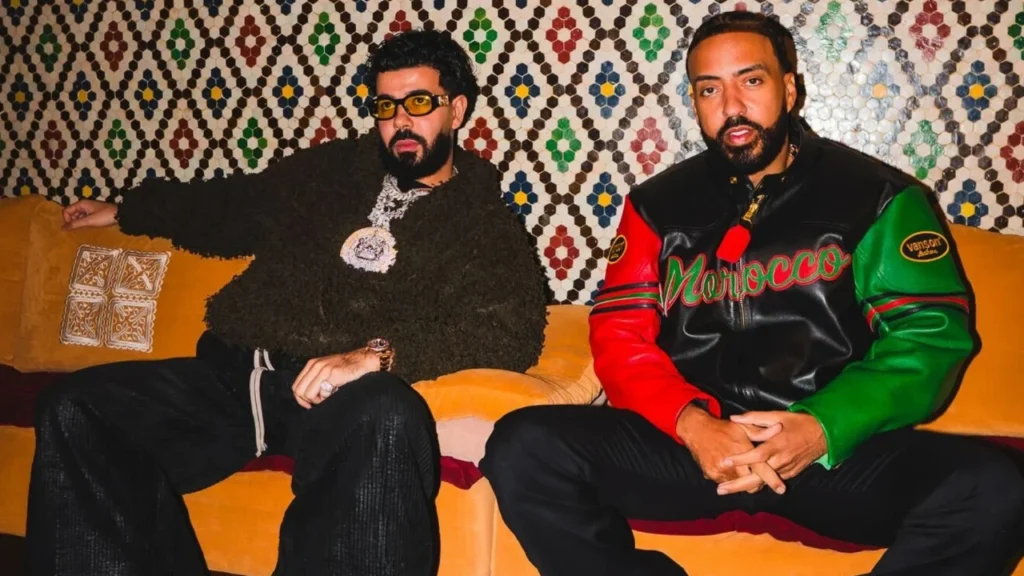
Montana’s Imagery: Mapping Morocco Through Cover Art
Montana’s discography functions as a visual and auditory archive of his homeland. From the beginning, his branding has been overt: His second mixtape, Live From Africa (2008), the title speaks for itself regarding his roots. His debut album, Excuse My French (2013), featured a young boy in Moroccan attire walking through what looks like the Sahara Desert. Bad Boy President Harve Pierre told Rolling Stone that the artwork is “about the journey of an artist that has come from Morocco to New York and worked his way to becoming one of Hip Hop’s hottest movements.”
The digital booklet of his second album, Jungle Rules (2017), was designed as a Moroccan passport. The tracklist and production credits were laid out across the passport’s cover and pages, interspersed with childhood photos of Montana and his mother back in Morocco. The cover of his twenty-third mixtape Mac & Cheese 5 (2024), features Montana illuminated by a Moroccan flag-light on his figure. The cover of Mac & Cheese Appetizer (a collab mixtape with Harry Mack, 2014) shows him with his mom in Morocco during his childhood.
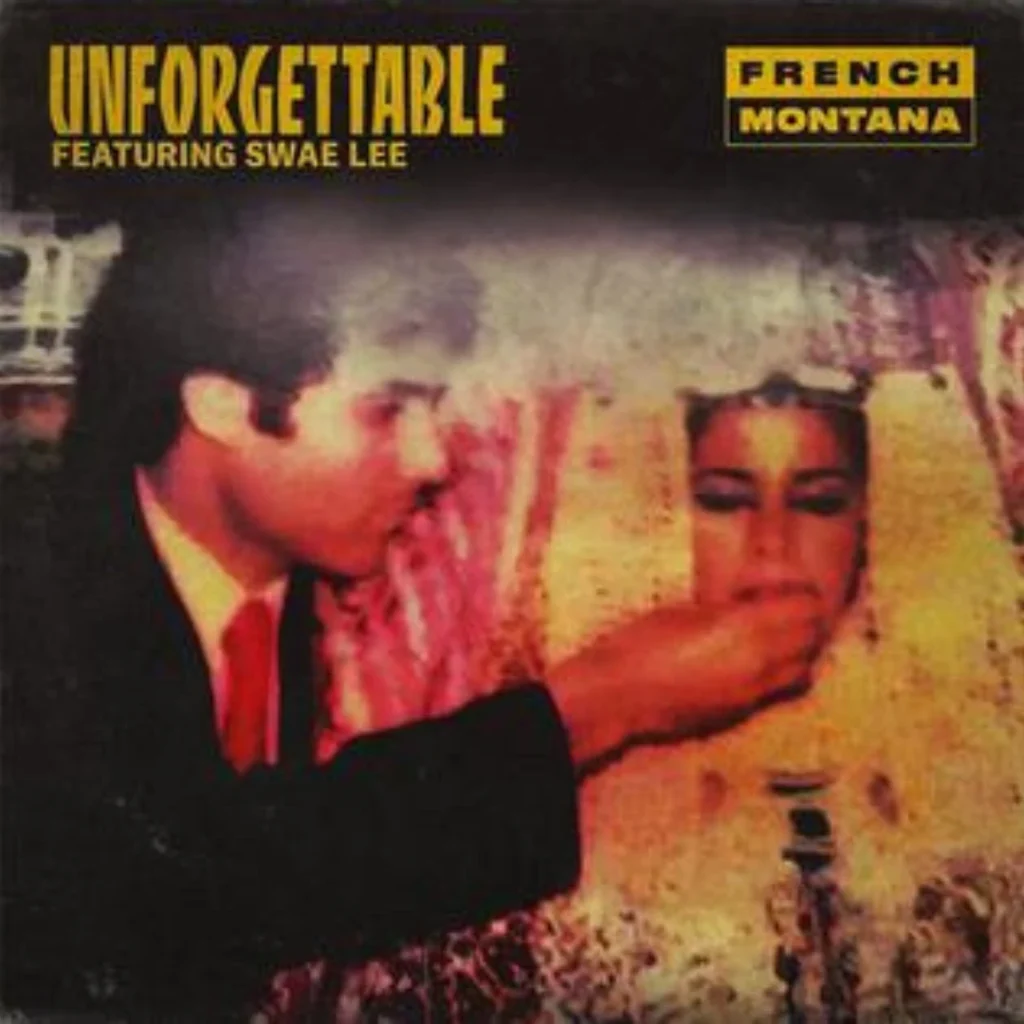
His most streamed and diamond-certified song “Unforgettable” (2017), features a cover of his parents’ wedding in Morocco. The cover of “One More Chance” (2024), the promo soundtrack for the For Khadija documentary, features a visual blend showing Casablanca’s iconic Hassan II Mosque, French Montana and his mother. Similarly, the cover of “I Can’t Lie” (2023), with Kodak Black features a picture of a kid Montana with his mother.
VIDEO: French Montana – Famous (Official Video) | Filmed entirely in Morocco.
Montana’s Vision: Showcasing the Landscapes of the Homeland
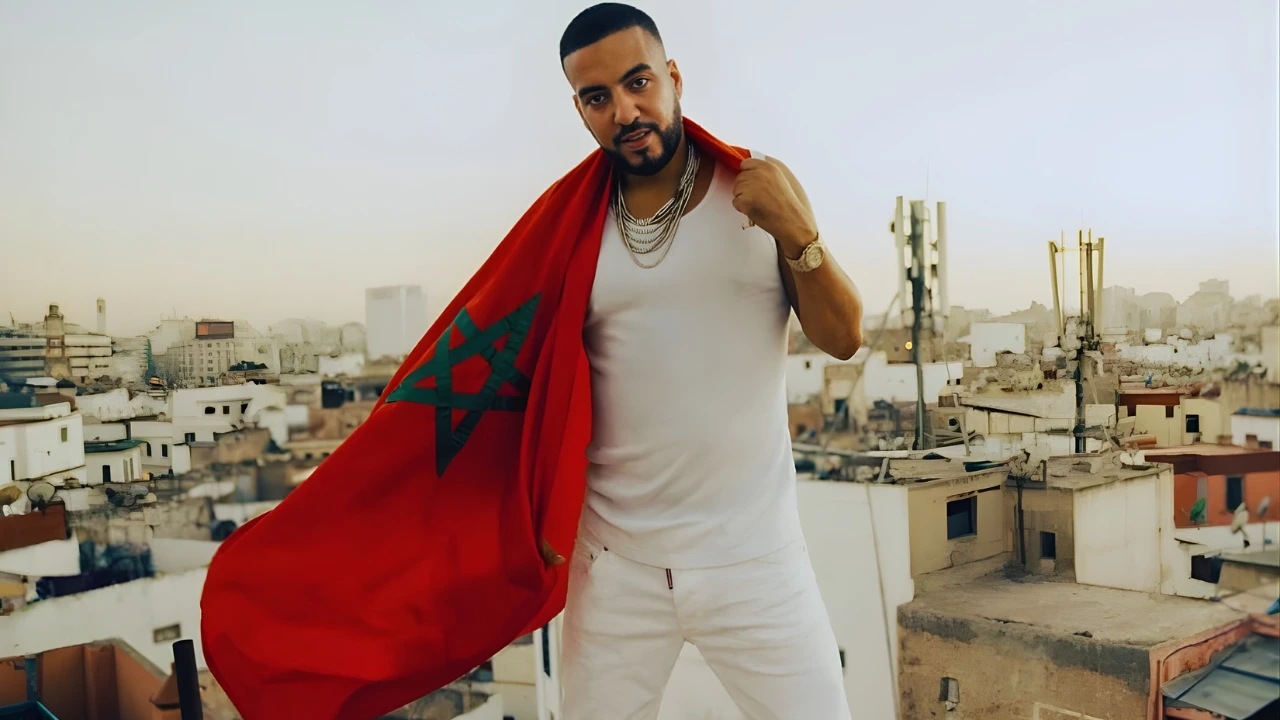
Montana’s music videos are frequently shot on location, serving as high-budget tributes to Moroccan geography. The video for “Famous” (2017) was filmed entirely in the Blue City of Morocco, Chefchaouen, and was framed as a visceral homecoming that included a visit to his grandmother’s grave. Similarly, the video for “Boom Boom” (2017), a collaboration with Moroccan producer RedOne, traveled through the Sahara Desert and various Moroccan urban centers. In “Casino Life”, he further emphasized this connection by filming at the Dar Al-Dabagh in Fez while wearing a Moroccan national team jersey, explicitly stating his goal was to “put Morocco on the map”.
His 2019 appearance at the Met Gala, a pinnacle of Western fashion, was a watershed moment for Arab/Amazigh representation. Wearing traditional Arabic garments on the first night of Ramadan, he challenged the Eurocentric “Camp” theme by presenting a regal, Muslim aesthetics that demanded space in a mainstream cultural institution.
Montana’s Language: Connecting the Diaspora through Dialect
Despite living in the United States for decades, Montana has made a conscious effort to preserve his native tongue. He credits his mother for this, as they never stopped speaking Darija at home. While he admits to a loss of natural fluency over time, he continues to conduct high-profile interviews exclusively in Darija with Moroccan outlets such as Hit Radio (with Momo), Farouk Life, and during Mawazine festival press conferences. He even made a video teaching American audiences his favorite Moroccan slang.
His commitment to his roots is captured by his 2018 Mawazine press conference. When a presenter began introducing him in French, Montana interrupted to request a switch to Moroccan Arabic, stating, “I don’t understand French, speak in Arabic.” The room erupted in applause. He even refused translation earphones when others tried to address him in French, insisting on the language of his people. During these press moments, he has shared his deep ties to Moroccan music icons, citing Moroccan chaabi singers like Fatna Bent Lhoucine and Stati as favorites, while Algerian rai icon Cheb Hasni as a his best artist during childhood. When asked about Morocco’s Crown Prince Moulay Hassan attending his set, he replied with pride: “That’s my king, that’s our king… it’s a success story.”
His lyrical content has increasingly embraced Arabic, providing a point of connection for the global North African diaspora: “Morocco” (2022), released during the national team’s historic World Cup run, he uses Darija phrases like Bs7a o Salama (congrats). “Ya Baba” (2025), a collaboration with Moroccan-Belgian artist Dystinct where Montana performed about half of his verse in Moroccan Arabic, the most of any of his tracks. Choices like “Salam Alaykum” (2019) from his third studio album Montana demonstrate a commitment to his heritage. He has also partnered with other Arabic-speaking artists on tracks like “Salam” (2022) with Saudi-American rapper Skinny and Swizz Beatz, and “Maghreb Gang” (2019) with Moroccan-German rapper Farid Bang and Algerian rai icon Cheb Khaled.
VIDEO: GQ Middle East x French Montana
Montana’s Impact: Building Schools and Supporting Communities
Montana’s success has fueled a model of networked philanthropy that prioritizes both long-term infrastructure and emergency mobilization. In October 2018, he funded the construction of two preschool classrooms at the Sabae School in Morocco’s capital, Rabat. By supplying books and infrastructure, he aimed to address the literacy gaps he witnessed growing up, arguing that education is a form of both academic and creative empowerment. He has expressed long-term plans to eventually establish music schools in Morocco.
His loyalty was activated in its most visceral form following the devastating 6.9-magnitude earthquake in September 2023, which claimed nearly 3,000 lives. While presenting at the MTV VMAs, Montana diverted from the script to announce an emergency relief fund in partnership with CARE and Global Citizen, personally contributing an initial $100,000.
Montana’s philanthropy is strongly tied to his Moroccan roots, when he donated 500 wooden canoes to the community of Makoko, Nigeria, he said: “as an immigrant from Morocco, giving back to communities in Africa, the place that raised me, is so important.” This follows his work in Uganda, where he helped build a three-story maternal health clinic.
Conclusion: The Unforgettable Legacy
Karim Kharbouch aka French Montana has redefined the “immigrant success story” by maintaining a visceral loyalty to his roots. His journey is marked by symbolic homecomings: his first return in 2012 where he noted, “you can’t recover 15 years no matter how long you stay,” and his 2015 visit where he reflected, “sometimes you gotta come back to your roots to see what made you”, to his live performances in Morocco, from Mawazine 2018 to Agadir 2023 and his 2025 headline set at the AFCON (CAF) in Rabat.
In his YouTube series Coke Boys TV (Ep 26: Lost In Morocco), he is seen returning to his childhood neighborhood in Casablanca, connecting with the people who share his origin. From the teenage boy who arrived in the Bronx speaking no English to the most-streamed African-born artist in history, Montana embodies his own mantra: “A lot of things are impossible until a fool came along and did it.”
Written by:
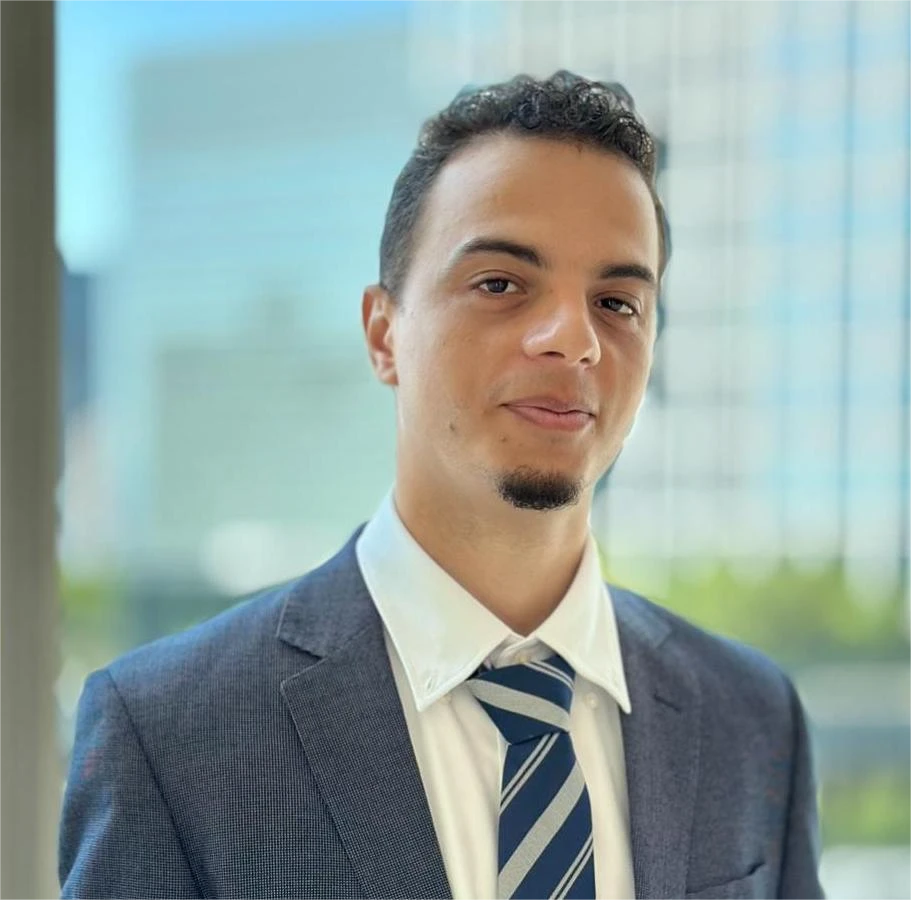
Ben Tarki Moujahid
Author
 View all posts
A music critic and a researcher, Moujahid writes in-depth articles analyzing Moroccan and global hip-hop, blending insights from industry experts into compelling, well-rounded critiques. Beyond writing, he plays a pivotal role in shaping the magazine's editorial vision, refining its tone, structure, and style to elevate the reader's experience. As the lead editor, Moujahid meticulously oversees and polishes nearly all published articles, ensuring the magazine maintains its reputation as a trusted and influential voice in music journalism.