Overman: The Amazigh Rapper Behind the Success of "Toqosi"
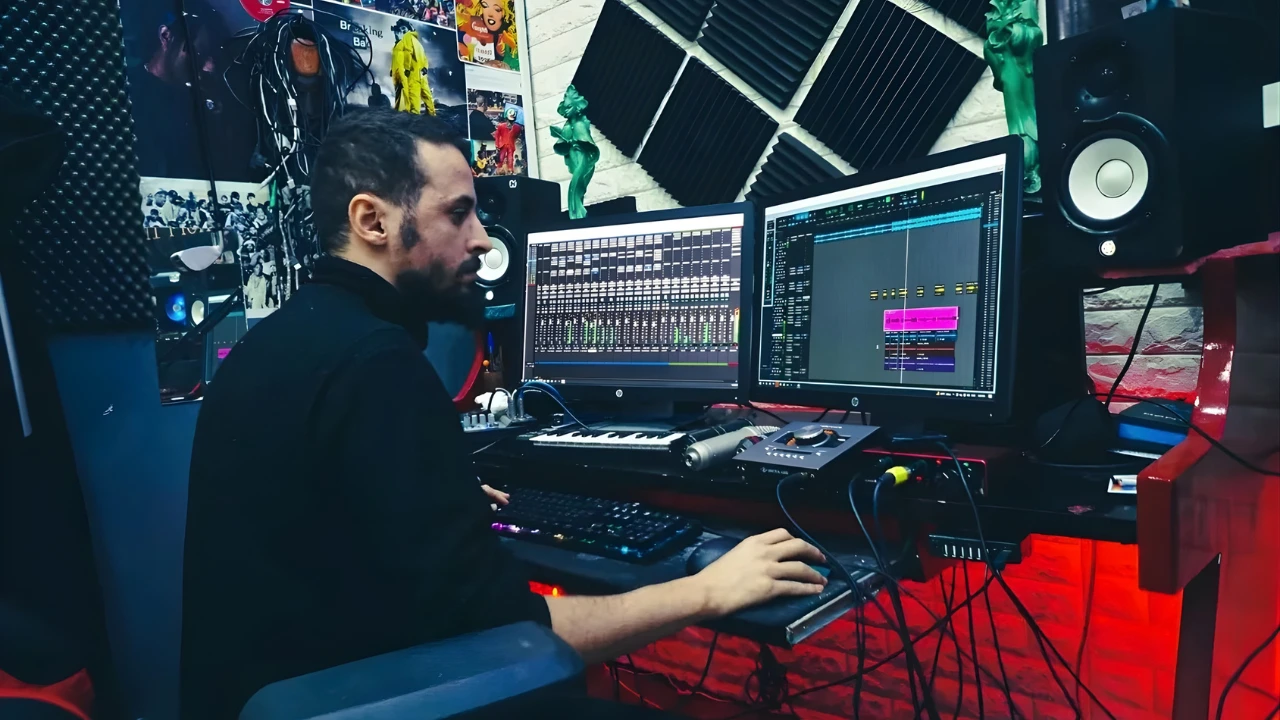
The Moroccan hip-hop landscape has been witnessing a profound shift as a new generation of artists digs into their ancestral roots to find their future sound. Among them is Abdesamad Moubsit, known professionally as Overman. Born in 2001 in Imintanoute, Overman has recently emerged as a voice for the Soussia language, one of the three primary Amazigh dialects of Morocco, spoken mostly in the south west region of the country. When he released the music video for “Toqosi” on August 10, 2025, something clicked. The track surpassed 100,000 views within its first week, becoming his first viral song and introducing him to a wider audience.
That success didn’t come without a story behind it, one that winds through a religious childhood, a pandemic-era awakening, a language switch, and a commitment to morap, the growing subgenre of Moroccan hip-hop that grounds itself in the country’s indigenous musical traditions. Morap, short for Moroccan Rap, also stylized as MoRap, distinguishes itself by weaving traditional instrumentation (such as the rebab, bendir or sintir) with samples from Morocco’s musical heritage and lyricism rooted in the country’s languages, primarily Darija and Amazigh. It’s a movement gaining real momentum, and Overman is becoming one of its voices.
In a conversation with DimaTOP, Overman discussed his path from a conservative upbringing in Imintanoute to finding himself in rap, his deliberate choice to embrace his native Soussia, the cultural craftsmanship behind “Toqosi”, and the politically charged music he’s preparing to release next.
From Imintanoute: How Overman Found Rap
Overman grew up in a religious household, recited the Quran regularly, and for a long time believed music to be haram (forbidden under Islamic law). It’s a perspective shared by many in conservative Muslim communities, rooted in a long-standing scholarly debate about the permissibility of music in Islamic jurisprudence, with opinions ranging from outright prohibition to full acceptance depending on context and school of thought. For Overman, it wasn’t until he sat with that question seriously that his stance shifted. “I grew up very religious, I’ve always read Quran and always thought that music is haram,” he said, “but after researching, I found it to be a misrepresented fact.”
The timing of that shift, as for many people his age, was the COVID-19 pandemic. Confined to home in 2021 and carrying years of accumulated listening, he found in music something that felt necessary. He had been a rap fan for years by then, at around nine or ten years old, he was listening to Moroccan rapper Spoo Pow (now believed to be Lferda), and by 2018, he had gravitated toward what is known in Morocco as “Deep Rap”, a thematic genre defined by its philosophical and introspective lyrics. “As you consume a lot, you create a mind of your own,” he said. “I never thought I would be a rapper… but since I was stuck during Covid, like everybody else, I felt like music is a refuge.”
VIDEO: OVERMAN 30 – TOQOSI (Official Music Video) Prod. by Mazyghmusic
Overman on Rapping in Soussia
Before discovering morap, Overman rapped in Darija, Morocco’s colloquial Arabic dialect and the long-established language of the country’s hip-hop mainstream. The shift came through a beat. “When I heard the beat of the song ‘Toqosi’, I felt my native language is the best fit,” he recalled. It was only after that instinct that he learned the sound he was responding to had a name: Morap. But the decision to commit to Soussia fully was also shaped by someone close to him. His friend and producer, recognizing something specific in Overman’s voice and delivery, encouraged him to make the switch. “He knows me and knows my skills and he has been a great supporter of mine since day one. I trusted him and switched.”
The transition wasn’t seamless. Soussia, or Tachelhit, is spoken primarily across the Souss, the Sous valley, and parts of the High and Anti-Atlas mountains in southern Morocco, and is one of the three major varieties of Tamazight recognized in the country (alongside Tarifit in the northern Rif region and Tamazight of the Middle Atlas). Rapping in it required Overman to find new rhythms, “when I started rapping in Soussia, I found it hard, but with time, I got used to. Now I love it,” he said. That love comes through clearly in how he describes the experience of writing in it: in Soussia, he says, his truest ideas and feelings come out, and in ways that Darija simply cannot match.
Toqosi: From an Instagram Reel to a Viral Song
The story of how “Toqosi” got its official release is a good illustration of what social media has done for independent artists. A representative from Noubal Media, a production company dedicated to Moroccan music content, came across an IG reel Overman had posted on Instagram featuring the track. They reached out with an offer: they would cover the studio and music video costs in exchange for releasing the song through their YouTube channel. Overman was skeptical at first, “I was doubtful at first, but after they contacted me the second time, I said let’s do it,” he recalled. The arrangement, straightforward as it sounds, gave the song a platform it might not have found otherwise, at least not on that timeline.
The results made the decision look obvious in hindsight. “Toqosi” (Arabic for ‘My Rituals’) crossed 100,000 views within its first week, a milestone that none of his previous releases had reached. His earlier work, including “K.F.L.”, short for “Koulchi Fyad Llah” (Moroccan for ‘Everything is in God’s Hands’), had gone largely unnoticed despite what Overman considers genuinely strong material. “The music video and the lyrics are fantastic, but still no recognition,” he said, adding a direct challenge to anyone reading: “I encourage you to watch it and judge for yourself.” The success of “Toqosi” marks a real turning point, and Overman has confirmed that more morap tracks with Noubal Media are already in the pipeline.
The Making of the "Toqosi" Music Video
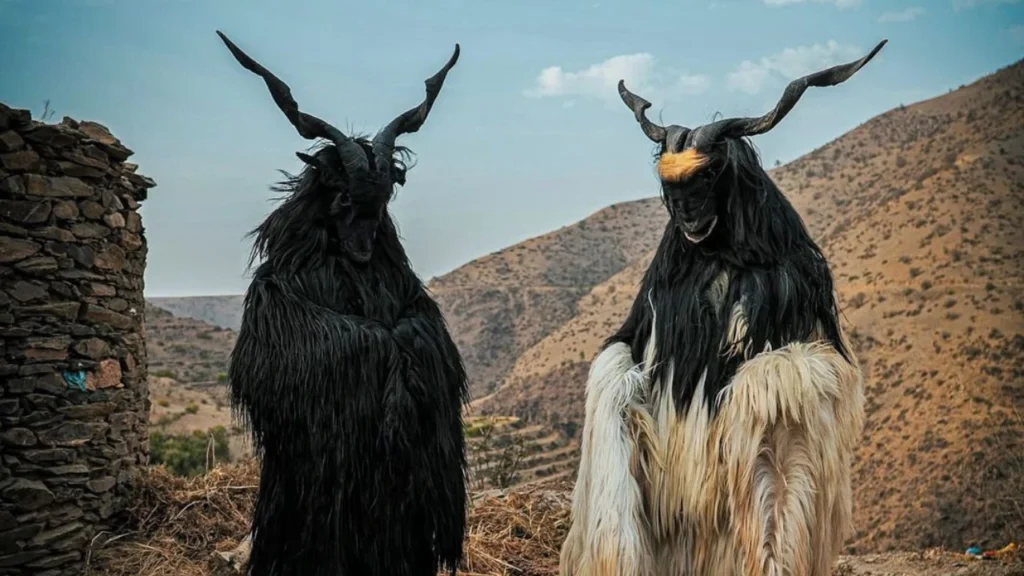
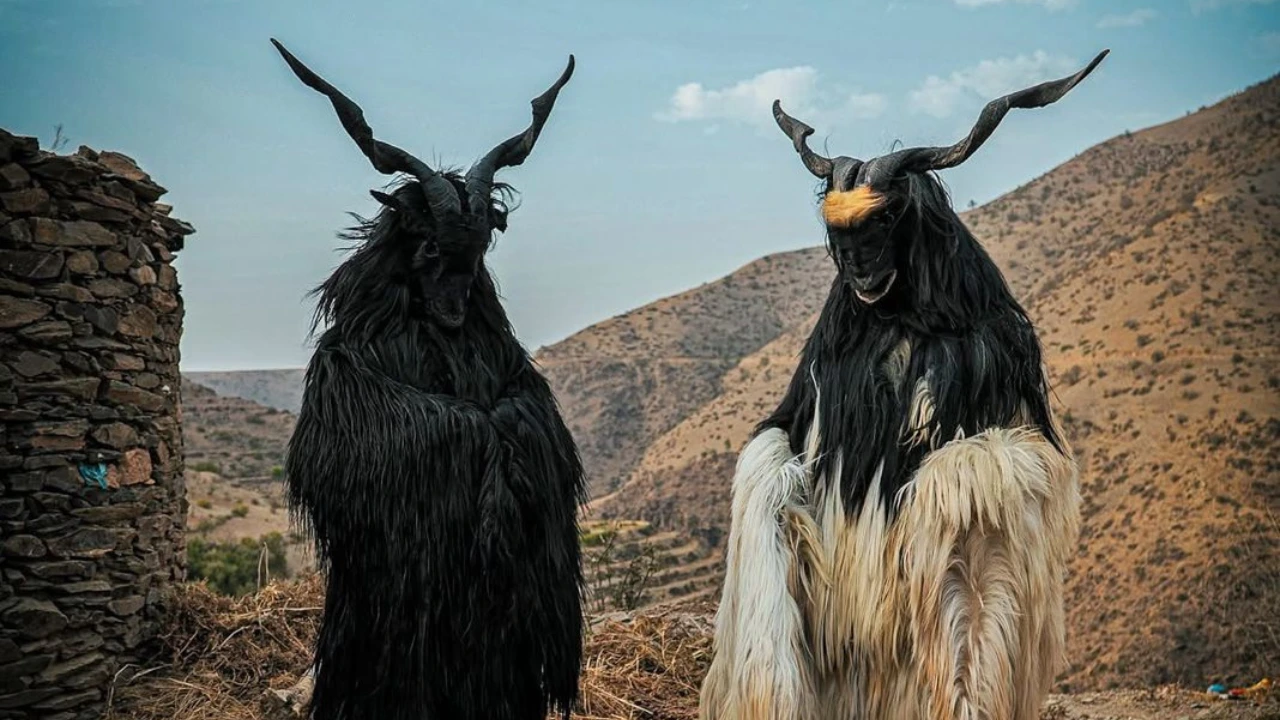
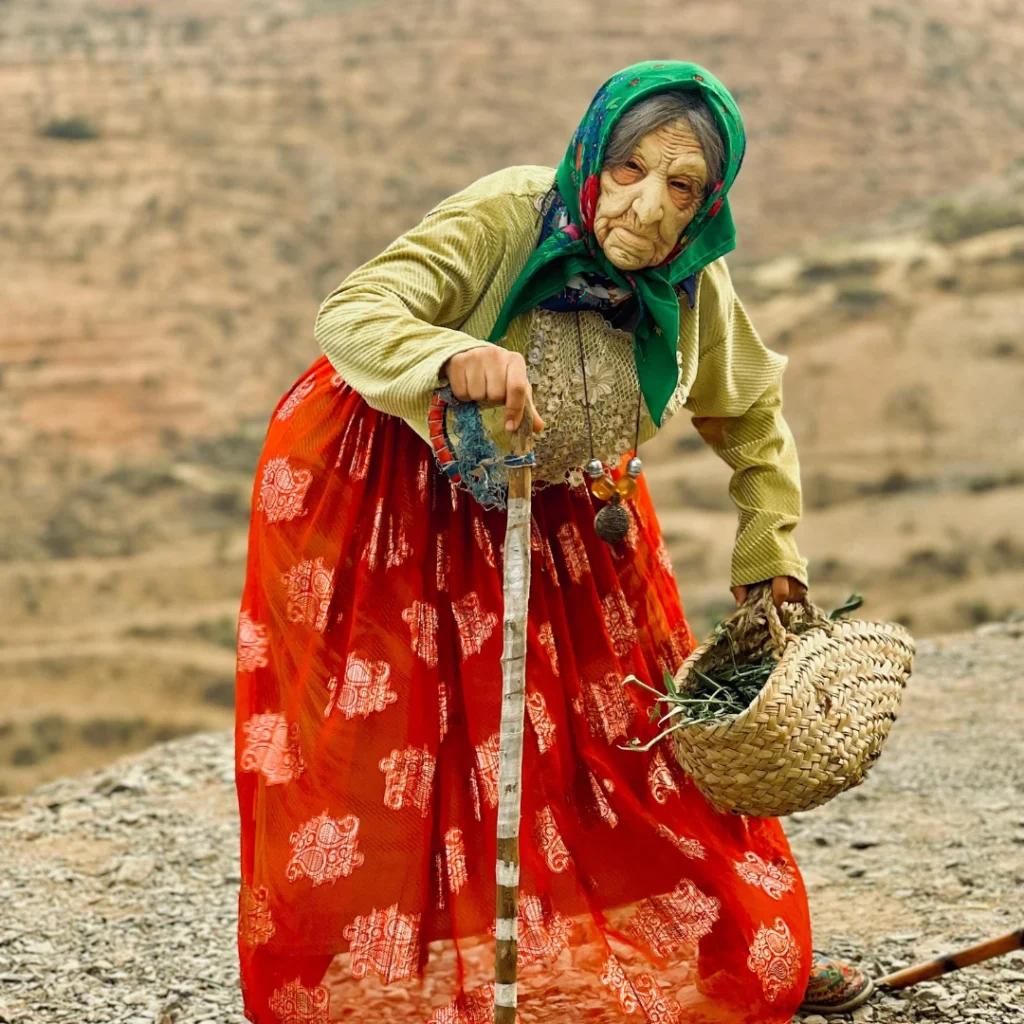
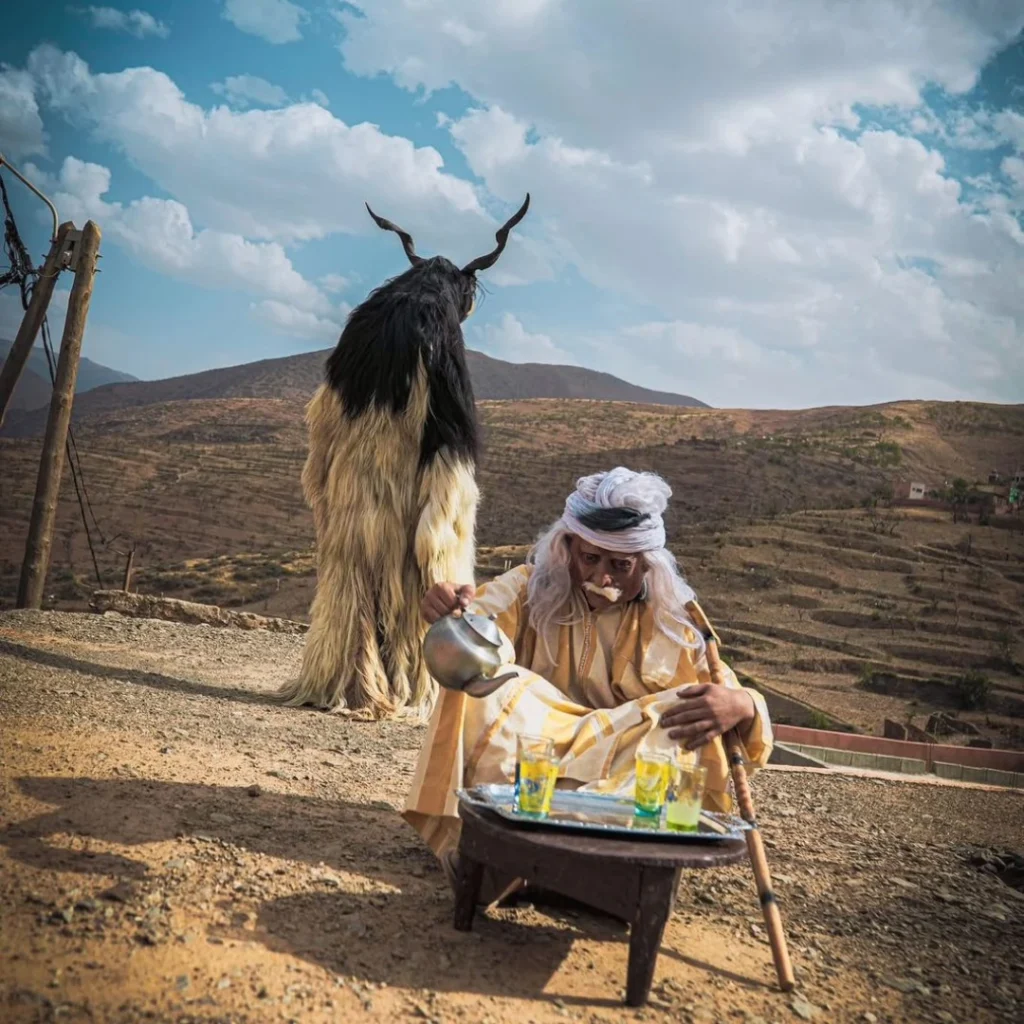
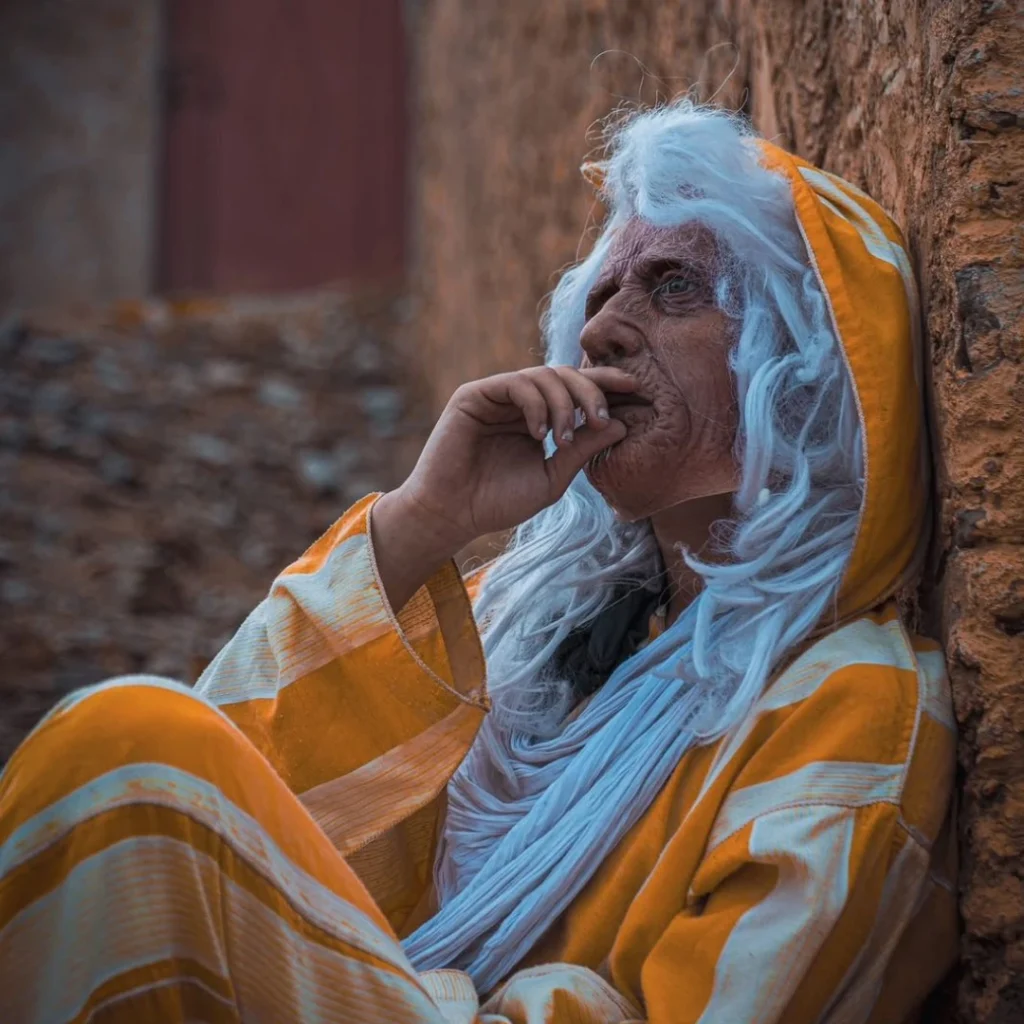
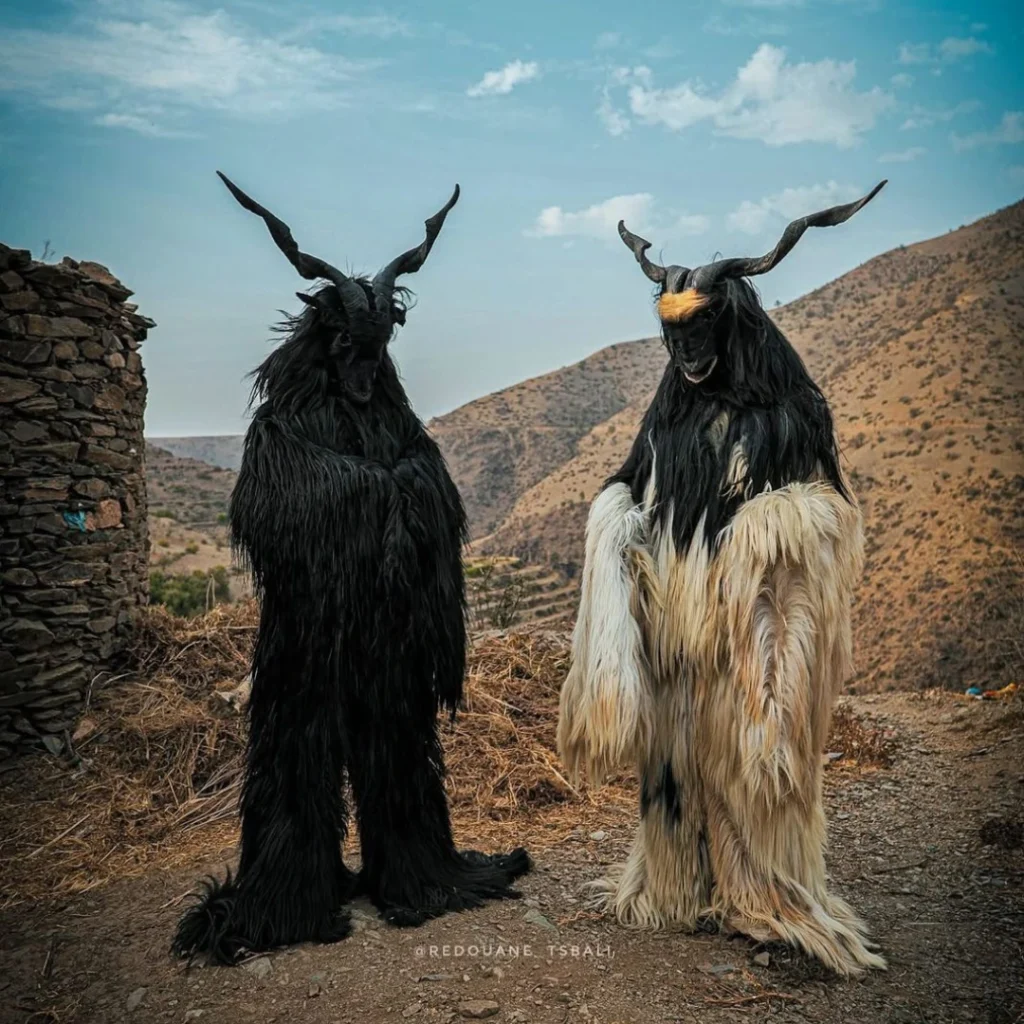
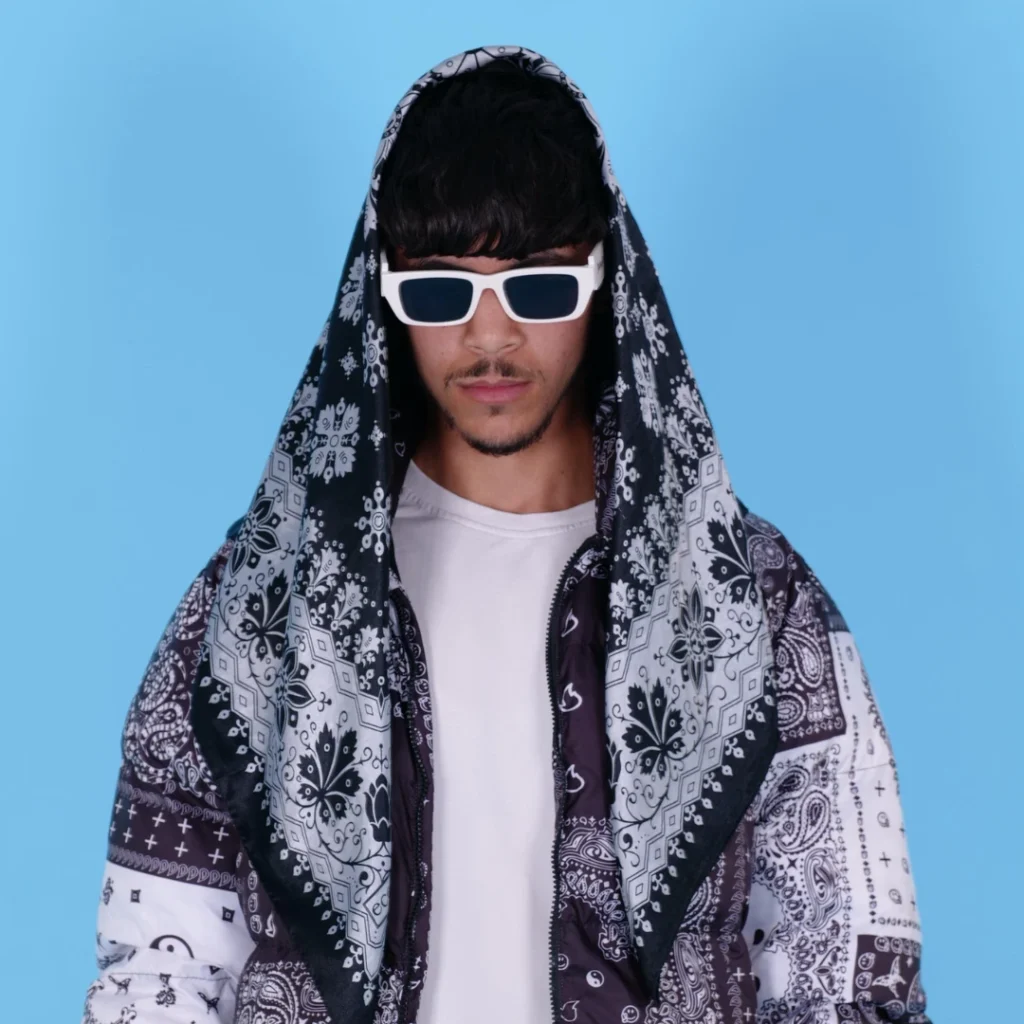
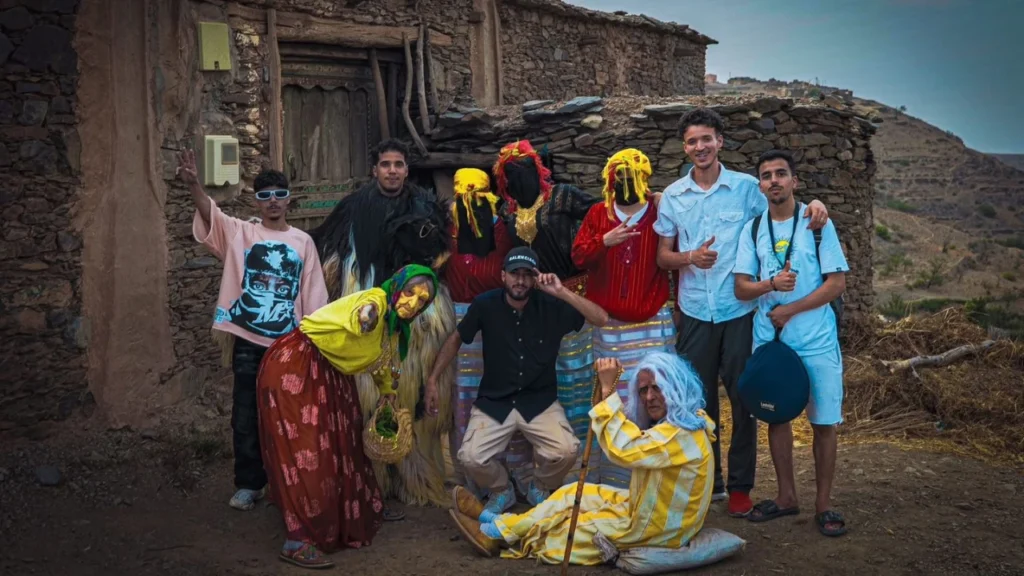
The visual for “Toqosi” is as culturally layered as the song itself, and it came together through a combination of deliberate planning, resourcefulness, and very good timing. The release landed in August, overlapping with L’Eid L’Kbir (the Great Eid), the Moroccan name for Eid al-Adha, and Overman recognized an opportunity to incorporate Boujloud, a traditional Amazigh festival observed during that period. In the Boujloud tradition, groups of participants dress in freshly slaughtered animal skins and move through their communities in a ritualistic procession that blends celebration, satire, and performance. In Imintanoute, as in many Amazigh communities, several such groups take part each year, each known as a “belmawn”, with the festivities lasting four to five days. The women participants are called “ti3ezza” and the elderly are referred to as “af9ir” (m) and “taf9irt” (f).
“I wrote the music video plan on a paper, and looked for Boujloud people, looked for some great spots,” Overman said. He reached out to one of the local belmawn groups, who took on the logistics of assembling participants, elders and young people alike. The shoot moved through the mountains surrounding Imintanoute, where the production team was met with remarkable generosity. “In the mountains, while filming, the people were the kindest. People welcomed us into their houses, gave us tea and sweets, and they wanted nothing in return,” he said. As Overman put it, Morocco’s well-known hospitality is multiplied tenfold in those communities.
The challenges were real nonetheless, finding locations that worked aesthetically for a rap video while also holding up culturally for the content they were filming, arranging transport across distances, and pulling everything together in a region far from a city’s conveniences. The whole project, audio and video combined, took roughly two months to complete, with the audio side proving more demanding than expected. Unsatisfied with the quality from his first studio session, Overman moved to a different studio entirely to re-record. “I knew I had a good song and didn’t want to lose due to poor audio quality,” he explained. Director Redone Tsbali brought it all together on screen. The result speaks for itself, but Overman is candid about where he places it: “You saw the quality, it’s only about 60% of what I wanted. Better things on the way.”
The Building the Sound of "Toqosi"
The sonic architecture of “Toqosi” is the work of several collaborators, each contributing a distinct layer to what became a great morap record. The beat was produced by Mazyghmusic, a graduate of Hiba Studio, whom Overman credits with a kind of effortless creative generosity: “I tell him an idea, he produces a better one”. But the element that arguably defines the song’s emotional register is the rebab, handled by Salah Fafah, a well-known player who has performed at venues inside and outside Morocco. “Salah Fafah killed it with the rebab,” Overman said. “That addition was instrumental to that morap sound, it’s the melody and the soul of the song”. The mix and master were handled by Back2b, whom Overman credits as “an experienced sound engineer and did his thing as it should be.”
The rebab is a bowed string instrument with deep roots in North African. In Amazigh communities specifically, it carries ceremonial and poetic weight, historically associated with imdyazn, itinerant poet-musicians who traveled between villages performing oral compositions. In the context of morap, incorporating it is both a cultural statement and an aesthetic one. Overman draws the comparison directly: “It’s one of the pillars of music in our Amazigh culture. It’s like the 808 in rap beats, very crucial.” The analogy is apt: just as the Roland TR-808’s bass drum became the foundational pulse of hip-hop and trap, the rebab brings both melody and emotional depth to morap. He adds that it “has a large fanbase as an instrument, we can just sit around and listen to the strings of that instrument and feel ecstasy.”
Overman sees morap as the most exciting development in Moroccan rap right now, and his enthusiasm is grounded in something specific. The movement has pushed back against a long-standing criticism aimed at artists who incorporate traditional instruments into hip-hop, the idea that doing so disqualifies them as “real rappers”, like what happened with hip-hop group Fnaire, and that Moroccan artists should default to imitating American aesthetics. “Many people have been using local instruments and got criticized for it,” Overman said. “Morap as a movement is solving this issue. There is a growing acceptance of native instruments and tongues”. For him personally, the movement also fulfilled a long-held creative desire: “I love listening to old Amazigh poems, I always liked the instruments and wanted to rap on one of those. With morap, I felt encouraged to do so.”
The Philosophy Behind the Name
When searching for a rap alias, Overman turned to one of the most discussed concepts in Western philosophy: Friedrich Nietzsche’s Übermensch, introduced in the 1883 work “Thus Spoke Zarathustra”. The Übermensch, literally “Overman” in German, represents Nietzsche’s vision of a human being who has moved beyond the constraints of conventional morality, social conditioning, and inherited norms, to define their own values on their own terms. It’s a concept that has inspired and provoked in equal measure across literature, philosophy, and culture for well over a century.
For Overman, it resonated on a personal level he could articulate clearly. “I am a lover of philosophy,” he said. “I read ‘Thus Spoke Zarathustra’ by Nietzsche. I took my name from the book, it’s like someone who is over social legends and norms”. His own trajectory, questioning religious assumptions he was raised with and making choices that diverged from expectation, maps to some degree onto that framework. “I was researching religion and many other concepts that we take for granted. I found myself in that character and in Nietzsche’s work, out of social chains,” Overman added.
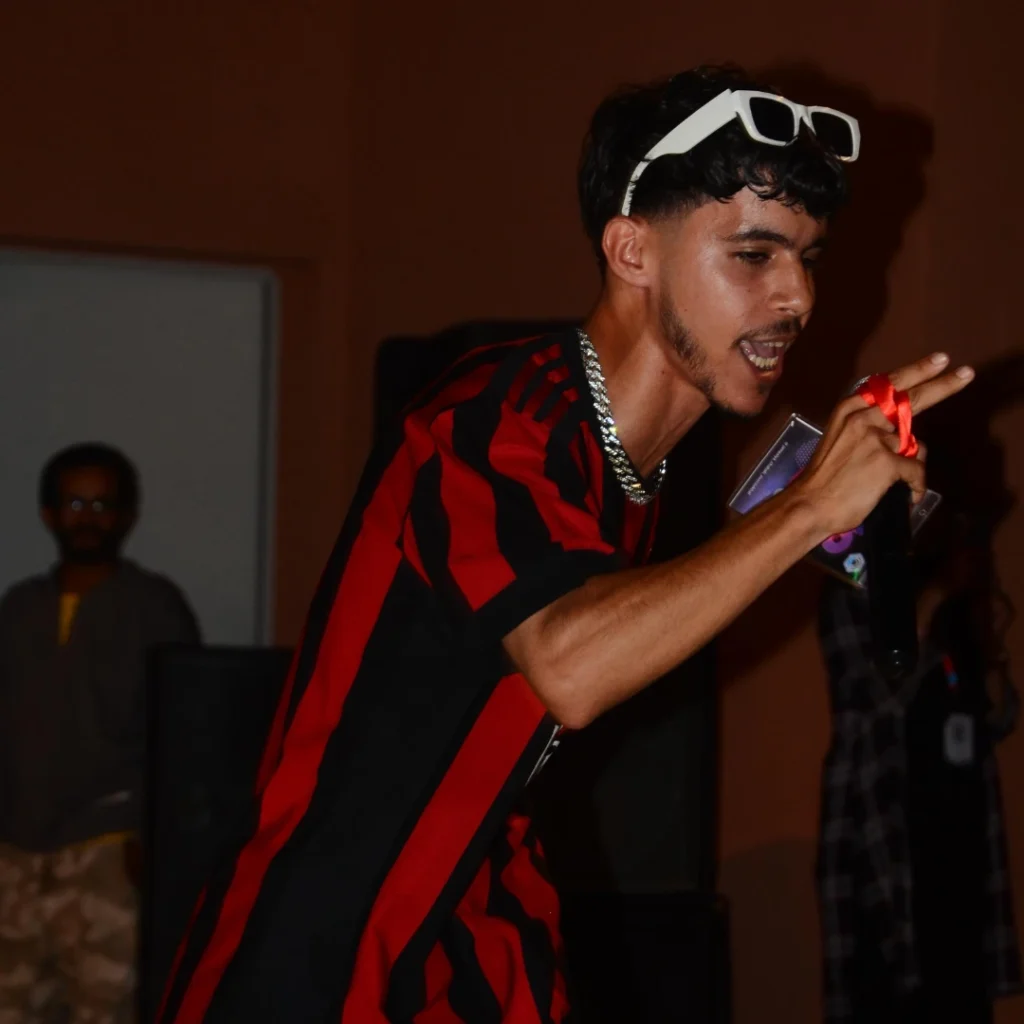
Overman on Amazigh Rap in Morocco
Overman’s perspective on the Amazigh rap scene in Morocco is shaped by genuine investment in it, and by honest assessments of where it still falls short. He sees the movement as culturally important, a way of giving new dimension to a community whose language has historically been underrepresented in contemporary music. “I think it’s great and important,” he said, “it gives a new flavor and vibe to the community”. When he writes in Soussia, something changes in the quality of what comes out: “I write better. It’s my truest ideas and feelings, way better than Darija.”
Within the scene, he draws a distinction between artists engaging seriously with social and political content and those whose work stays closer to ego and performance, the kind of status-driven lyricism that dominates rap globally. He respects both approaches but gravitates toward the former. He’s understanding about why many artists stay in shallower territory: “Amazighia first feels hard, and ego is easier to write about,” he said, adding that most tend to focus on easier material.
Two artists come up when he discusses the scene’s range. PAUSE is a rapper he identifies as someone who confronts political topics directly, and Overman notes that Amazigh listeners “relate to that on a deeper level”. Iguidr, another rapper from the Agadir region who also raps in Soussia, brings a different strength, technical skill, distinctive flow, and a coolness factor, without focusing as heavily on subject matter, which Overman respects in its own right. His own position is clear: “As a minority language speaker, it’s a responsibility to reflect our region’s struggles.”
Overman's Grandmother Who Battles in Verse
One of the most striking threads in Overman’s story is the connection between his own artistic ambitions and a far older tradition living right inside his family. His grandmother is a poet, in the tradition of Amazigh oral poetry, where verses are composed, performed, and exchanged with real craft and competitive intent. She battles other poets. Sometimes face to face, and sometimes through a kind of literary correspondence: she writes a poem, sends it with a messenger to a specific person, who composes a response and sends it back, a slow, deliberate exchange rooted in a poetic tradition that predates hip-hop by centuries.
“When she recites her poetry, I don’t understand it even though it’s in Amazigh, it’s so deep and nuanced,” Overman said, “that’s so inspiring for me”. For Overman, his grandmother’s craft is both a source of wonder and a point of personal aspiration. He has considered featuring her on a track, ideally as a voice introducing a song, though he’s realistic about the complications. “The family is quite conservative,” he explained, “I will try my best to have her at least do an intro for me”.
What Overman Is Building Next?
The most anticipated of Overman’s upcoming tracks is “L7ouz”, a song addressing the aftermath of the September 2023 earthquake that struck Morocco’s High Atlas Mountains. The disaster, centered in the Al-Haouz province, which gives the track its name, killed about 3000 people and destroyed entire villages in the region, making it one of the deadliest earthquakes in Morocco’s recorded history. The government’s handling of the disaster and the pace of reconstruction have been subjects of sustained criticism, and for Overman, the topic is anything but abstract. He is from that part of the country, and he has lived its realities, saying “I am one of those who lived the experience of walking 10km+ to go to school, under the rain. It’s not an exaggeration, some of us really live that over here”.
A collaborator and friend advised him against releasing the track, calling it “too political” and “crossed the red line” as it criticizes “some names”, but Overman has held his ground on the core of the song. The hook takes direct aim at the government’s crisis response, and the verses address children in the Atlas Mountains contending with cold, inadequate schooling, poor healthcare access, and the harsh conditions of remote life in the region. The song also criticizes the prioritization of large-scale infrastructure, specifically stadium construction, over hospitals and schools, a criticism that has grown more pointed as Morocco invests heavily in football infrastructure ahead of co-hosting the 2030 FIFA World Cup. Overman speaks from lived experience on this point: “I feel like I want to express what I feel, what I see, what I live. I don’t want to change my lyrics,” he said.
A second track in development, titled “Tabrat”, meaning “message” in Amazigh, is an old-school beat with rebab. The first line, Overman says, translates roughly to “rap wants a message, not just dancing”. Beyond these two projects, Overman describes a creative process that never really pauses. He freestyles constantly while walking, plays beats in his head, and builds out hooks and fully formed songs mentally without ever committing them to paper. “I have songs with their hooks and all in my mind, never written on a paper,” he said. “I am always ready for a mic”.
Conclusion: Bringing the Atlas Mountains to the Mic
Overman is, at twenty-four, still in the early stages of what looks like a carefully considered career. “Toqosi” connected him with an audience that hadn’t found him yet, but everything about how he talks about his work, the philosophy, the language politics, the cultural specificity of the Boujloud video, the grandmother whose poetry he can’t fully decode but studies anyway, points to someone building with good foundations. He knows the difference between what has been made and what could still be made, and he says so directly: the video was sixty percent of what he had in mind. Better things are on the way he says.
What makes him worth following is the combination of a grounded identity, in Imintanoute, in Soussia, in a community that walks ten kilometers to school in the rain and sun, and an intellectual interest that leads a young man from the Atlas foothills to Nietzsche and to centuries-old Amazigh oral poetry traditions. As the Morap movement continues to gain momentum, Overman stands as a reminder that the most powerful message is one that is delivered in the tongue of your ancestors.
Written by:
Ben Tarki Moujahid
Author
 View all posts
A music critic and a researcher, Moujahid writes in-depth articles analyzing Moroccan and global hip-hop, blending insights from industry experts into compelling, well-rounded critiques. Beyond writing, he plays a pivotal role in shaping the magazine's editorial vision, refining its tone, structure, and style to elevate the reader's experience. As the lead editor, Moujahid meticulously oversees and polishes nearly all published articles, ensuring the magazine maintains its reputation as a trusted and influential voice in music journalism.