Shams Dinn: Pioneer of Arabic Rap Who Refused to Sell Out
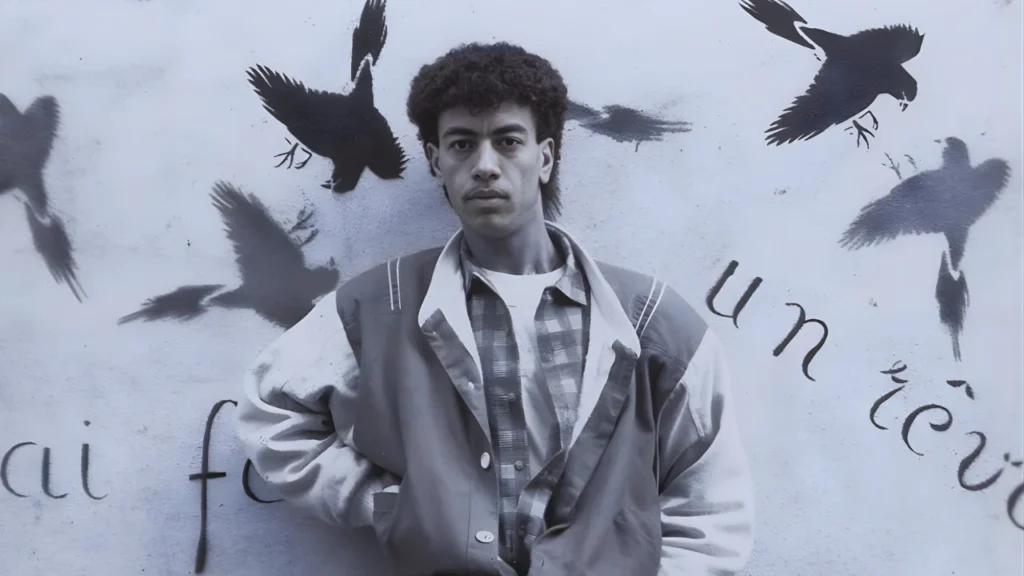
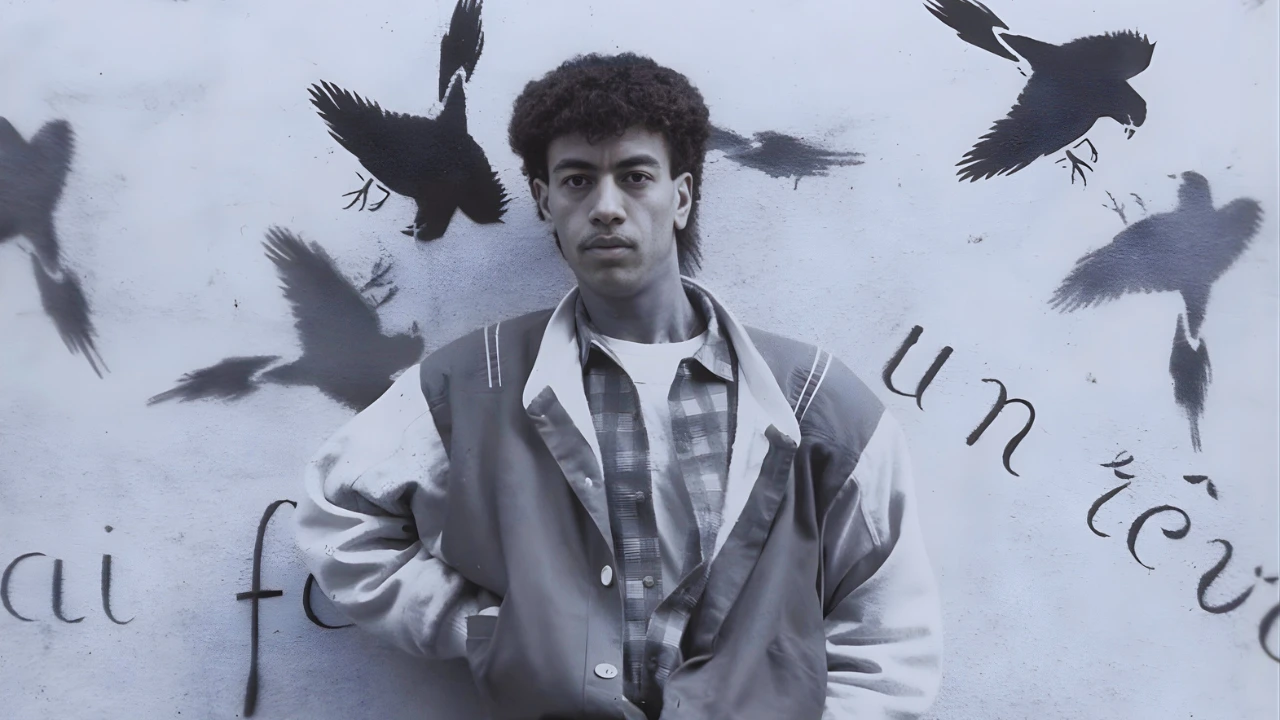
Mohamed Ben Bouchta aka Shams Dinn was born in Oujda, a city in northeastern Morocco near the Algerian border, in the early 1960s. His father died before he was born, and he was raised by his grandfather, a figure described as a Sufi ascetic whose spiritual orientation left a lasting imprint on Mohamed. The Arabic stage name he would later adopt “Shams Dinn” (meaning ‘Sun of Faith’), reflects this Sufi inheritance directly, though he also noted with humor that when spoken quickly, the name sounds like “James Dean”.
He emigrated to France with his mother at a young age (between the age of 7-10), settling in Lyon. His formative years were spent in Lyon, a city with a large immigrant population that he later described as deeply embedded in soul and funk music. Growing up, he was drawn to the nascent underground hip-hop scene, as well as martial arts, graffiti, and breakdancing. He and his friends, part of a crew he named the Couscous Clan, a satirical reference to the Ku Klux Klan, would lay down cardboard and break dance to records by Kurtis Blow and Melle Mel.
His musical diet was wide: through parties he organized with friends, he consumed rock, soul, funk, and early American rap, while at home his parents played mostly classical Arabic music. Rap, however, was conspicuously absent from Lyon’s cultural landscape. “From a rap perspective, there were no groups or DJs in Lyon. It was a total desert,” he told Red Bull. Shams was also frank about his view of the French rap scene developing around him. He expressed appreciation for the group Assassin but was critical of rappers who, in his view, imitated American styles without recognizing the differences in their daily realities. “We don’t live the same problems,” he said. “France is paradise compared to the United States.”
The Bet: Paris with 500 Francs and Meeting Sidney
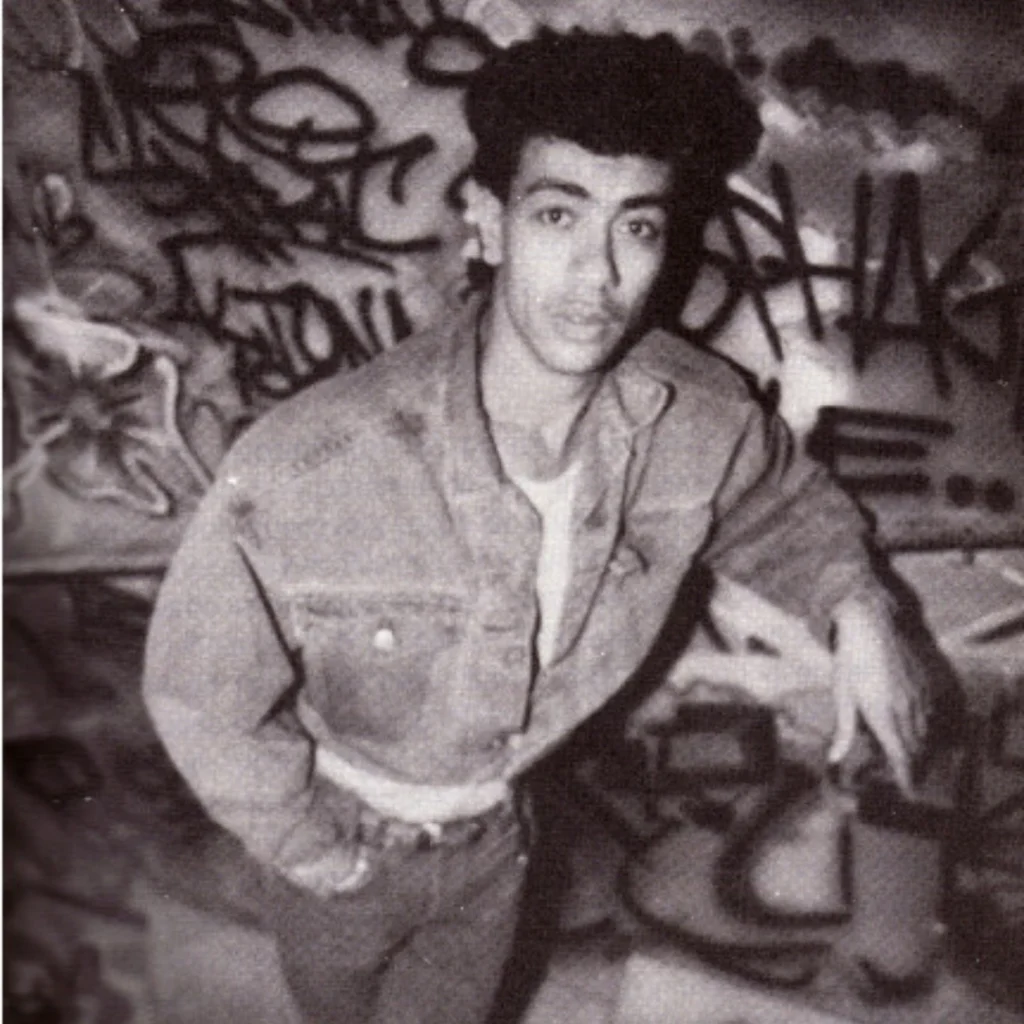
The decisive moment came one afternoon in late 1985, when Shams Dinn was sitting in Lyon with a group of friends, discussing social tensions. He put a challenge to them: he would travel to Paris with only 500 francs in his pocket and return with the first Arabic rap record ever made. His friends, skeptical that France would ever accept an Arabic rapper, bet he couldn’t do it.
The following year 1986, Shams Dinn arrived at Paris, found a youth hostel, paid for three nights in advance, and set about navigating an unfamiliar city with 350 francs remaining and no contacts. He wandered through Châtelet, struck by its social mixing, and found himself one night standing in a line outside Le Palace, one of Paris’s most storied nightclubs of the era. He tried the VIP entrance, it worked, and inside he found himself in a space that would change the course of his life.
That night at Le Palace, the DJ was Patrick Duteil aka Sidney, a pivotal figure in French hip-hop and the host of the television program H.I.P.-H.O.P. on TF1, where he had been instrumental in introducing American urban culture to French audiences. Sidney spotted Shams Dinn near the booth, noticed he was rapping to himself, and offered him the microphone. Shams Dinn began flowing in Arabic and the crowd responded warmly. He left that night with two phone numbers and an invitation to a studio session.
Days passed and leads dried up, but fortune intervened again in the neighborhood of Barbès, where Shams Dinn ran into a former acquaintance from Lyon: Djamel “Jess” Dif, the drummer for Carte de Séjour, the influential Maghrebi rock group formed by Rachid Taha in 1980, who had relocated to Paris after leaving the group in 1983. Dif had since started a label called Hamedi Records, a distribution company created specifically to release Arabic music. He agreed to co-produce Shams Dinn’s record, but only if Shams Dinn could contribute 15,000 francs to the project.
Shams Dinn returned to Lyon, took out a loan with his girlfriend, and came back to Paris. Together, he and Dif booked Studio Mania, run by a musician named Ahmed where, as Shams Dinn described it, many Arab and Black artists of the Paris scene gathered. Dif had also worked on recordings for prominent raï artists, including Cheb Khaled and Chaba Fadela.
VIDEO: Shams Dinn – Hedi Bled Noum
Hedi Bled Noum: The First Arabic Rap Single?
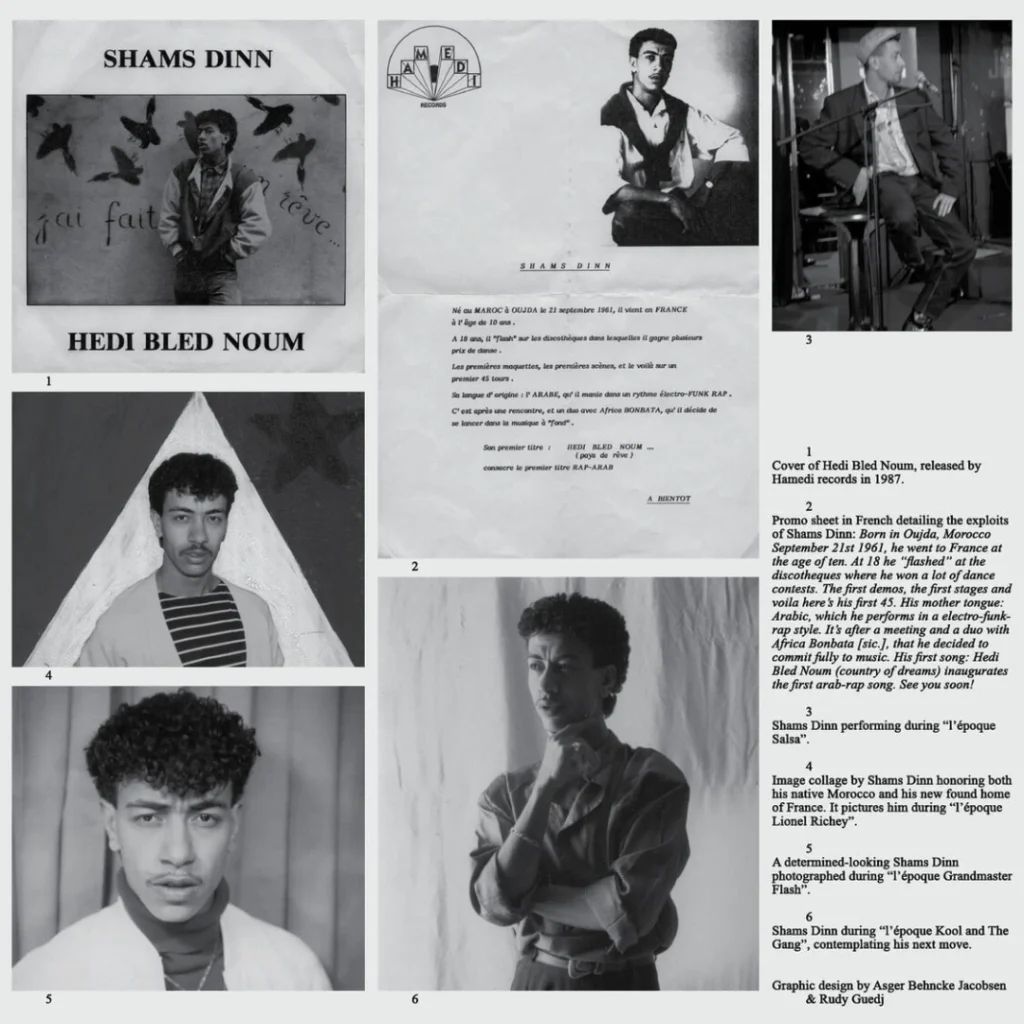
In what Shams Dinn later described as barely an hour of recording, “Hedi Bled Noum” was captured on tape. Dif polished an electro-funk beat; a synth player improvised his part; Shams’s girlfriend contributed vocals, which were sampled into the track. The song’s title translates roughly as “This is a Land of Sleep”, or “The Land of Sleep” a phrase that served as a call to consciousness. The cover of the 7-inch bore the graffiti inscription “I had a dream…”
The song’s message of awakening, of calling a sleeping community to attention, aligned precisely with what Shams Dinn said he set out to do: a “positive light for Arabic immigrants living in France,” at a time when identity was questioned and belonging was sometimes threatened.
Released on Hamedi Records in 1987, “Hedi Bled Noum” became a success. It lit up dancefloors across Europe and reached number one on Radio Médina, a station that broadcast across cities along the northern Mediterranean coast, where it reportedly held the top spot for five months. The record gained attention not only in France but in North Africa, and its fusion of P-funk, Stevie Wonder-influenced grooves, and Arabic lyricism was unlike anything being made in France at the time. It has since been described by reviewers as cruising “between P-funk and Stevie Wonder,” a track that managed to feel simultaneously ancient and futuristic, a truly timeless song.
The Album, the Contract and the Gulf War
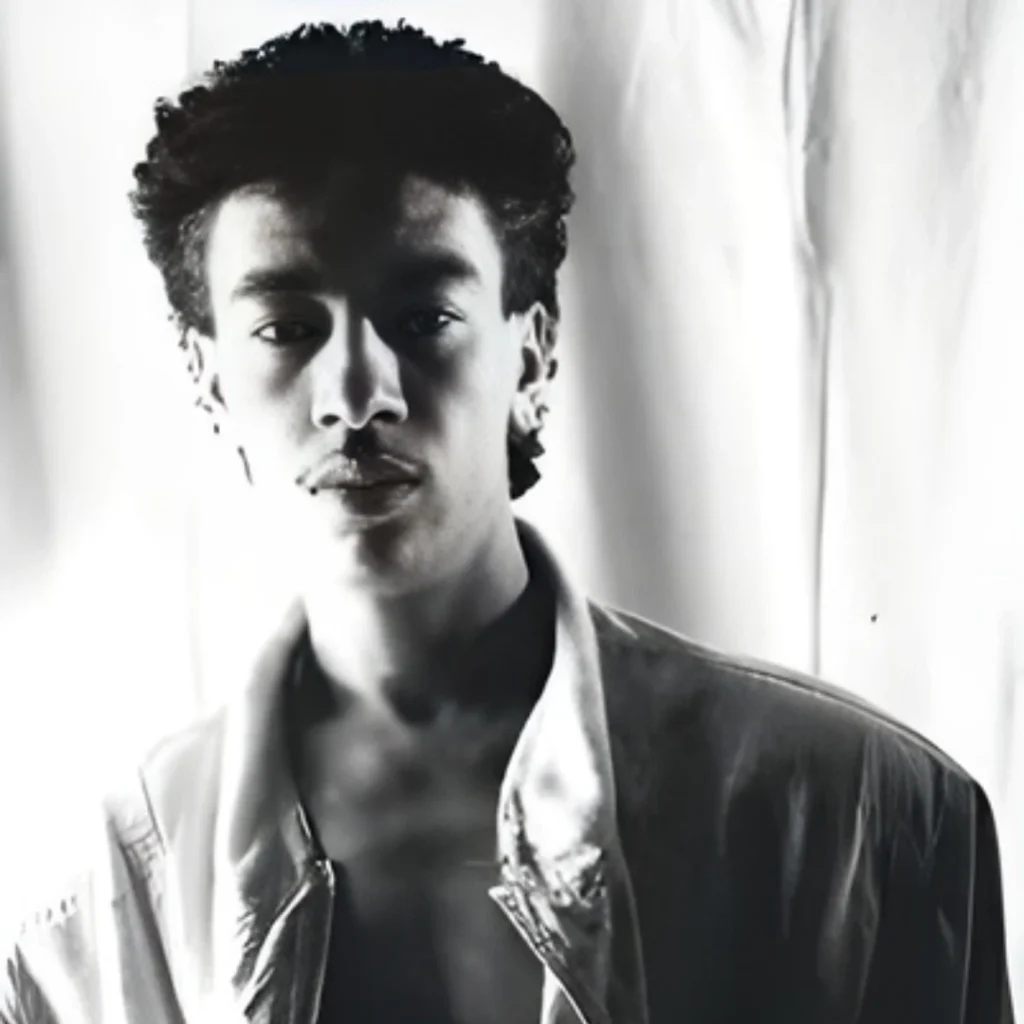
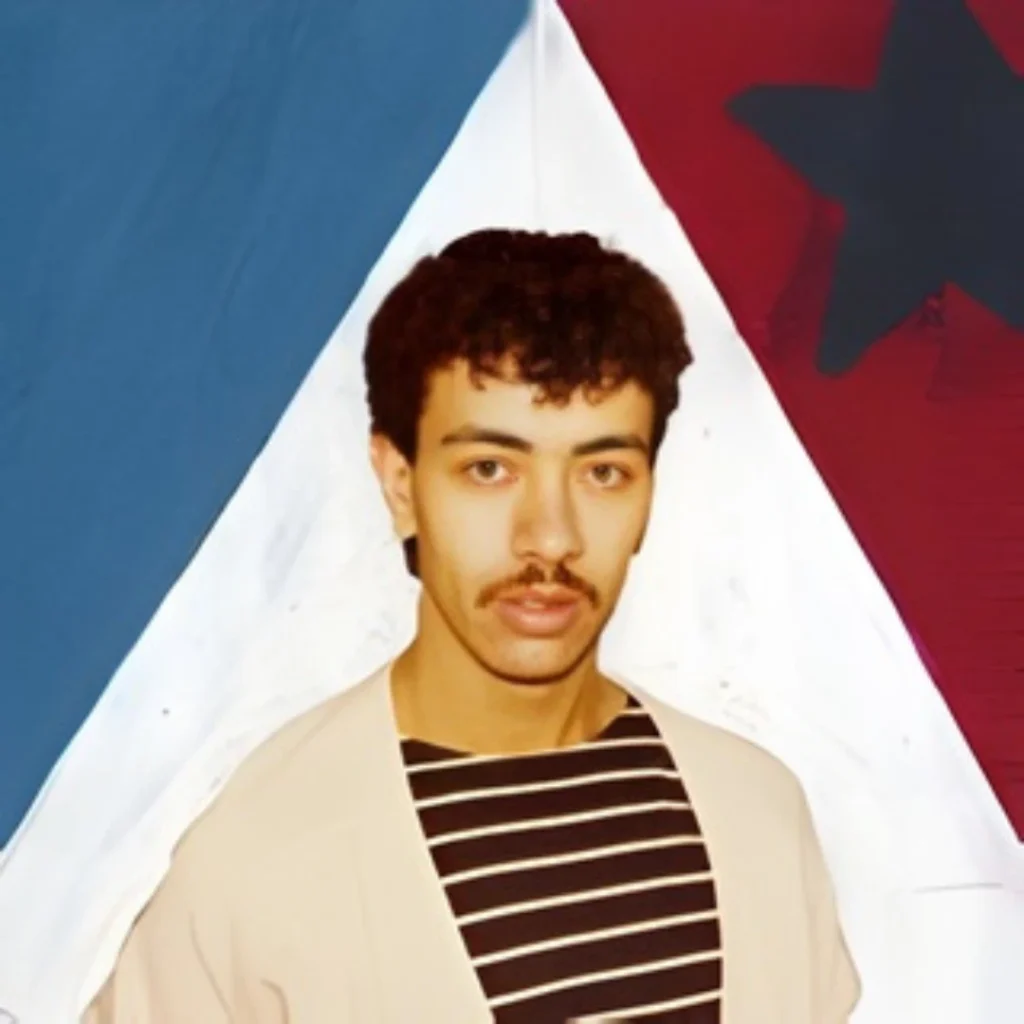
In 1991, Shams Dinn encountered Jean Soullier, a producer from Modane who had made his own name under the alias Gino Palatino with the hit “Qu’est-ce que tu viens faire à Paris?” and had since worked across a range of styles. Soullier spotted Shams in a press book outside a studio on Avenue de l’Opéra, Shams was then sporting what he described as a “Kid Creole look: hat, scarf, thin mustache, loose suit”, and offered him a full album deal on the spot.
The two worked together for five months in a 24-track studio near Marne-la-Vallée that had previously belonged to Jacques Dutronc. Soullier brought a more festive, Italo-pop grooves; Shams brought the funk. The collaboration produced seven completed tracks, and BMG had initially agreed to release the album.
But fate, and the outbreak of the Gulf War, had other plans. At the final meeting to sign the contract, the label reversed its position entirely, presenting Shams Dinn with a stark ultimatum: re-record his lyrics in French, or the record would be shelved. Citing the hostile political climate and an explicit directive that there would be “no Arabic on the airwaves,” the company made clear its reluctance to promote Arabic-language music. Shams Dinn refused categorically. The album was shelved and remained officially unreleased.
The tracklist of the aborted album, as documented, comprised seven songs: “Hedi Bled Noum,” “Rai Al Mal Boule,” “Shams Dinn (Wald Bladi Zine),” “Vieille France,” “Ane Dassi Mwe,” “Sleke Machine,” and “Hedi Bled Noum (Instrumental),” along with “Toutes Ces Femmes.”
The music itself, as described by reviewers, was an inventive fusion of styles. “Rai Al Mal Boule” carried a sleek bass line suited to late-1980s house music; “Ane Dassi Mwe” and “Shams Dinn (Wald Bladi Zine)” blended rap passages with traditional Moroccan vocal textures; “Vieille France” was a funk piece inflected with irony about his adopted country; “Sleke Machine” was described as showing “his stormy side”; and “Toutes Ces Femmes” was an Orient-minded instrumental.
The production drew on drum machines programmed to evoke hand percussion, clipped guitar chords, warm analog synths, and a vocal approach that moved between rap and song. Reviewers have compared elements of the record to Chicago house, Nancy Noise–era hip-hop, and Ofra Haza’s globally inflected pop, the kind of eclectic reference points that suggest how unusual the work was for its moment.
Following his dismissal from the label, Shams Dinn did not abandon his relationship with music or community. In the years that followed, he worked at a school, where he taught children how to rap and express themselves through language. The distributor Rush Hour, which later handled the reissue, described this chapter as a deliberate continuation of the same project.
The Smiling C Reissue and the Reconnection
In 2018, the record label Smiling C, released a self-titled compilation album assembling the most significant recordings from across Shams Dinn’s career, spanning material made between 1985 and 1990, in their “first ever reissue” saying “with a chance to dig through Shams’ archives, we’ve assembled [an] eponymous debut LP”. The release included a remastered version of “Hedi Bled Noum” taken from the original tapes, songs from the shelved album, and a number of previously unreleased demos. The limited edition pressing came with a sticker and an inner sleeve containing photographs and an interview with Shams Dinn.
The release was met with genuine critical enthusiasm. One reviewer described the album as “a true melting pot of Moroccan roots, French upbringing and American influences,” awarding it 8/10 points and noting that “the combination of Maghreb music and funk has not been too common.” Another called it a “long-lost gem that merges North African rhythmic sensibility with the futuristic aesthetics of early electro and hip-hop.” The Smiling C reissue represented, for many listeners, a first encounter with work that had circulated only in limited form for decades.
Shams Dinn's Place in the History of Moroccan and Arabic Rap
Pinpointing Shams Dinn’s exact place in the lineage of Arabic rap remains difficult due to the scarcity of archives from that era. While he has almost always been described as the first Moroccan rapper – and all evidence still points to that as a fact – and while his 1987 single “Hedi Bled Noum” is widely cited as the first Moroccan rap record, and one of the first, if not the first, in Arabic, recent research has complicated that narrative.
It has recently been discovered that the earliest known Moroccan rap record is actually by funk singer Bob Fadoul, aka “Morocco’s James Brown”, whose 1985 single “Amarni Nanssa” (I Will Never Forget) from his album Reggae Marocain, is now regarded as the first rap record in Darija (Moroccan Arabic), though Fadoul is not categorized as a rapper. This discovery was made by Moroccan archivists Biriebi3 and the collective DOSEI, the latter being the founders of the Egregore Festival. They timed the festival’s second edition, held 26th-27th July 2025, to coincide with the 40th anniversary of the song, and thus of hip-hop in Morocco, with a line-up of 40 rappers celebrating four decades of the genre.
What is beyond dispute is that Shams Dinn was among the first people anywhere to record and release a rap single in Arabic, that he did so in France at a moment when hip-hop in any language other than American English was largely unrecognized, and that he did it entirely on his own terms. The title “Hedi Bled Noum” carried within it the central proposition of his entire project: that a community that goes unheard is, in a sense, asleep, and that the act of speaking in your own language, in public, to an audience that may or may not understand you, is itself a form of waking. Shams Dinn was a pioneer of Arabic flow.
Conclusion: a True Pioneer with a Voice That Wouldn't Be Silenced
Mohamed Ben Bouchta arrived in Paris with 500 francs and a bet that no one believed he could win. The bet was that France would accept an Arabic rapper. The answer, in the end, was complicated: he was accepted by audiences, dropped by a label, and vindicated by history. He chose a name that meant the sun of faith, because faith, for him, was not merely spiritual but also artistic and communal: the belief that language carries light, and that the light is worth carrying even when the industry turns away.
To close, let the voice of Shams Dinn speak for itself. From the first verse of “Hedi Bled Noum”:
"Mahmoni ghi lwlad li zadou f had lblad —

I'm concerned about the kids born in this country [...]

Matnsach f had layam, noum f Franca maydoum —

Don't forget, in these times, sleep in France doesn't last."
Written by:
Ben Tarki Moujahid
Author
 View all posts
A music critic and a researcher, Moujahid writes in-depth articles analyzing Moroccan and global hip-hop, blending insights from industry experts into compelling, well-rounded critiques. Beyond writing, he plays a pivotal role in shaping the magazine's editorial vision, refining its tone, structure, and style to elevate the reader's experience. As the lead editor, Moujahid meticulously oversees and polishes nearly all published articles, ensuring the magazine maintains its reputation as a trusted and influential voice in music journalism.