5 Music Videos to Understand Moroccan Comedy Rap
Comedy rap, sometimes called “Towaba rap”, meaning sarcastic rap in Moroccan Arabic, is one of the most enduring and widely misunderstood subgenres in hip-hop. At its core, it weaponizes humor, absurdism, wordplay, and satire to say things that a straight-faced verse might never get away with. It is a tradition nearly as old as hip-hop itself, tracing back to artists like Biz Markie and the Beastie Boys, who proved early on that you could make people laugh and still be lyrically formidable.
In the modern era, comedy rap found a new generation of champions who each occupied a different corner of the genre: Ludacris made party anthems out of braggadocious absurdity (Act a Fool); Action Bronson smuggled strange humor into a tough-guy package (Actin’ Crazy); Lil Dicky built a whole career out of self-deprecating, meta-humor (Jail); Afroman turned a blunt haze into chart gold (Crazy Rap); and Hopsin used sharp satire to skewer rap culture from within (Sag My Pants). Not to mention the rappers who have fully crossed over into comedy, names like Childish Gambino (stand-up & Atlanta series); Vince Staples (The Vince Staples Show); Redman and Method Man (How High). And the you got those who don’t even try, rappers like Snoop Dogg, 50 Cent, Kevin Gates, and Cardi B.
The differences between these artists matter: some deliver hard bars over silly visuals, some hide brutal commentary inside absurdist punchlines, some are comedic only in select tracks while remaining deadly serious elsewhere, and some maintain the same sense of humor so consistently it becomes their signature. Then there are those who started one way and evolved, and those who simply never broke character.
Moroccan hip-hop is no different. From the early 2000s onward, a homegrown comedy rap scene took shape, one that blended the irreverence of its American counterparts with distinctly Moroccan cultural references, Darija wordplay, and the kind of neighborhood humor that could only land if you grew up watching a pot of harira heat over a small gas cylinder in a rooftop room. These artists were not making jokes for the sake of clout, they were using humor as a lens through which to examine politics, poverty, identity, and street life. Below, five music videos serve as essential entry points into this rich and underappreciated corner of Moroccan music.
1. "Lmoutchoukistan" by Lmoutchou
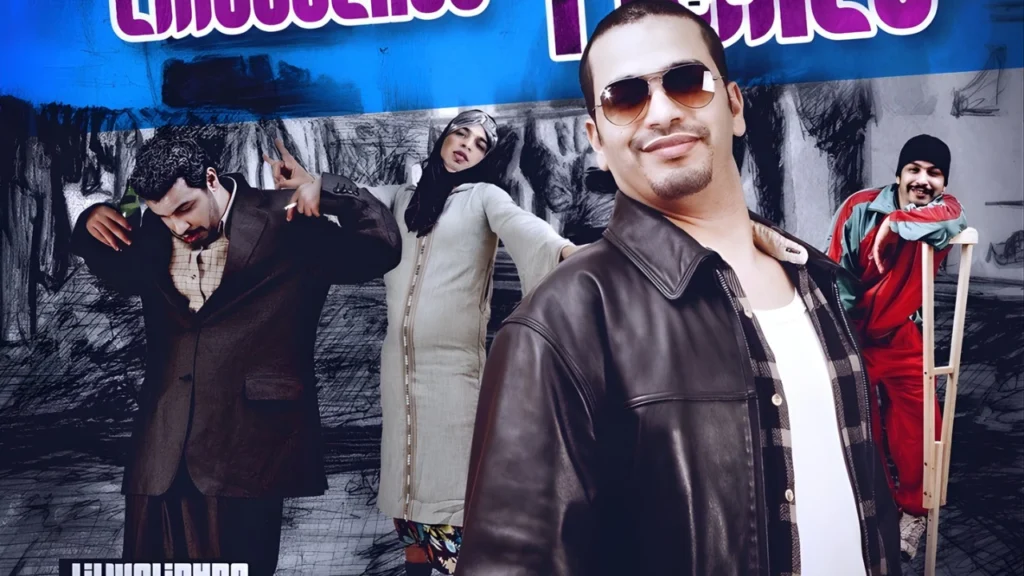
Lmoutchou aka Mobydick, born Younes Taleb in 1978 in Rabat, is arguably the godfather of Moroccan comedy rap and, by any honest measure, one of the greatest lyricists the country’s hip-hop scene has ever produced. Active since the ‘90s and still going, he has accumulated a back catalogue of great hits, a reputation for classic freestyles, and remarkable debut – and, to date, only – album, Lmoutchou Family (2010), which stands as a landmark release in the comedic genre. But what makes Lmoutchou a truly singular figure, beyond his skill and longevity, is the cultural shift he engineered almost single-handedly.
Before him, incorporating comic references into rap, especially Japanese anime and American superheroes refs, was considered childish and unserious, unbecoming of the art form. Lmoutchou dismantled that notion. Through elite lyricism and a deep, demonstrable knowledge of hip-hop culture, he normalized referencing and even embodying anime characters, most notably Luffy from One Piece, as well as superheroes, particularly Superman, whose iconic logo he appropriated as a personal emblem, replacing the ‘S’ with its Arabic equivalent ‘M’.
Uploaded on November 13, 2011, “Lmoutchoukistan” is an absolute classic of the genre and arguably the document of Moroccan comedy rap’s golden era. The video opens with Osama bin Laden rowing a small boat alongside several Al Qaeda members, the premise being that he survived, and is now en route to a new home. A map appears on screen charting the journey from Afghanistan all the way to Morocco, the destination labeled Lmoutchoukistan (the Land of Lmoutchou).
What follows is a full satirical spectacle: Mobydick plays “Osama ben Lmoutchou Laden,” joined by Yes First as “Mullah First Omar,” Lionbad as “Cheikh Noris,” and “Cheikh Noel.” All four are decked out in exaggeratedly fake beards and armed with toy guns, they even let off the tinny toy gun sound effect at the end when the “shooting” begins, ensuring no viewer could mistake the mockery for anything else.
The diss itself is pointed: aimed squarely at America, and at Obama specifically for his failure – in this alternate universe – to finish the job. The hook drives it home: “Hada clash gameover, bghiti t’souva khwi twin x4 / Golo l Obama Osama ba9i 7ay x8”, (This is a diss track, game over; you wanna live, leave the twin [towers] x4 / Tell Obama: Osama is still alive x8). The climax sees the U.S. Army tracking them down just as they’re about to sit down for lunch, and rather than a fire fight, bin Laden extends an invitation to share a Moroccan tajine. The soldiers accept. When an army trades firepower for a warm meal, you know you’re deep in satire. The video ends with Lmoutchou, still in character, moonwalking. And yes, Mobydick Jackson can dance.
2. "L'ordonnance" by Lionbad
Lionbad aka Sheikh Nores, born Badr Tmanoukti in 1990 in Taza, is a Rabat-based rapper and a central figure within Adghal Records, Lmoutchou’s hip-hop collective and label that became one of the most creatively interesting hubs in Moroccan rap. A consistent collaborator with Lmoutchou, as evidenced by his appearance in “Lmoutchoukistan” and “1.3.2.1”, Lionbad made his mark during the mid-2010s with a style defined by confident yet nonchalant delivery and cynical yet tough lyricism.
Nonchalant and proudly so, he once revealed in an interview his plans to title his first mixtape “Attafawou9 fi 3adam tassawou9” (Superiority in Nonchalance), a name that says everything you need to know about his aesthetic philosophy. His definition of a rapper is equally revealing: “someone who has the art of throwing out jokes, comments, and witty remarks in front of others, making them laugh.”
Uploaded on August 30, 2014, “L’ordonnance” is among the finest comedy rap tracks the Moroccan scene has produced, and remains one of Lionbad’s most widely recognized songs. The setting itself is a provocation: instead of rooftops overlooking glamorous cityscapes or anything remotely aspirational, the video is shot on the rooftop of a modest house, where Lionbad and his friends are chatting and cooking. It is deliberately, almost aggressively un-hip-hop, and that is entirely the point.
The opening line alone is worth the price of entry: “represent l bu2s b7al buta sghira f bit f sta7, fu9ha barmita btata siq bla l7em ba2iiisa” (I represent misery like a small gas cylinder in a room on the rooftop, on top of it a pressure cooker with only potatoes and no meat, so miserable). Every image in that line is an immediately legible poverty marker for a Moroccan listener: the small butane gas cylinder as a symbol of bare-minimum living; the pressure cooker full of vegetables with no meat; the rooftop room as a real, lived housing reality for far too many people. In a single compound image, Lionbad captured the texture of economic precarity.
That tension, between rap’s inherent braggadocio and the humility of the subject matter, is what gives the track its cynical genius. The second verse sharpens that cynicism into outright social critique: “nod seb ach ghaytra, wakha m9assi b m3al9a d dhab l caviar, ghaykhra l khra, b7al dyalk, tfoo, y9dr ykun khnaz” (Speak up; nothing will happen to you. Even if they eat caviar with a golden spoon, they still shit just like you, maybe even stinkier).
3. "Tyson" by Dollypran
Dollypran, born Mehdi Ghazoui in 1997 in Casablanca, began as a topliner for other Moroccan artists before launching his own solo career in 2012. His music occupies a very specific niche, a “local irony rap” a style that marries a drill-sonic palette with bars so absurdist and layered that listeners frequently lose the thread entirely, unsure whether they’ve just heard something hilarious, something profound, or some strange fusion of both.
He is one of the most unique lyricists in Moroccan hip-hop, one whose comedic writing gets so insanely constructed that casual listeners can get easily lost. In any given Dollypran track, you will find several moments of absolute lyrical genius buried in what sounds like a haystack of random word combinations. Though the longer you listen, the more you suspect the apparent randomness is the point. He lowkey be spitting.
Uploaded on August 30, 2024, “Tyson” is a the kind of comedy rap that hits harder the more attention you give it. Named after Mike Tyson, but also, with remarkable filial tenderness, after Dollypran’s own father, the song carries that duality right into the artwork: the cover and several shots within the video show his father bearing a face tattoo that mirrors Tyson’s iconic tribal design. It is an absurd visual choice but somehow makes sense. The video itself features Dolly surrounded by his B13 crew and his father, a recurring setup across his videography, as well as footage of the group on motorbikes, pulling wheelies and other tricks.
Amid all of this comes one of his most celebrated double entendres: “7na li katla9na wa9fin fl jalsa”, on its surface, “we’re the ones you find standing at the court hearing,” but in Arabic, jalsa (court hearing) literally means “the sitting,” which means they stand when everyone else is seated, at once a metaphor for defiance and individuality, and also a casual admission of run-ins with the law. Two meanings, one line, zero wasted syllables.
A similar gem surfaces in “Lmossiba,” where, right after the hook, Dollypran opens with: “Flousk ou ma7sabtihomch, ma7addak 3aych f danya ghatchof chi 7yawj malbastihomch” (You didn’t even count your money; as long as you’re alive, you will see some things you’ll never get to try on). In Moroccan Arabic, chi 7yawj means both “some things” and “some clothes,” and malbastihomch means “you didn’t wear.” The double meaning transforms what sounds like a throwaway bar into a quiet meditation on the unknowability of life , there are so many experiences, like so many clothes, that you will simply never get to try on. So why stress about calculating every step, counting every dirham?
4. "Boom" by Mr. Danger
Mr. Danger, born Hamza Elouarrak in 1994 in Casablanca, arrived at exactly the right moment. In 2012, the Moroccan rap scene was riding a full West Coast wave: the pioneer M.Doc was seeing a well-deserved rise in recognition, and a young Dizzy DROS was emerging as a new power player, bringing a polished, West Coast-inflected sound to a scene hungry for it. Into this moment stepped Mr. Danger, armed with dope delivery, infectious energy, satirical visuals, and a debut mixtape, Moul Chi, whose lead single “Boom” would make him a near-overnight sensation.
The name itself came courtesy of fellow rapper Magma, who upgraded him from “Dangerous Man” to Mr. Danger, a christening that stuck. He also claims in the song to have started rapping in 2006 at just 12 years old, making him, by his own account, the youngest rapper in El Barnoussi, Casablanca, before going on to complain that by 2012, the scene had gotten crowded.
Uploaded on August 18, 2012, “Boom” is interesting precisely because it inverts the usual comedy rap formula. Where some of the other videos on this list pair satirical lyrics with relatively straight visuals, “Boom” does the opposite: the bars and delivery are tight, and the West Coast energy is genuine. Part of the hook runs “haz ydik m3aya lfou9, la9i sba3 ydik bjouj, west coast bouji m3ana bouge” (Hands up high with me, put your fingers together, it’s West Coast, move with us), bars that could sit comfortably in any serious set.
But the video is pure, uncut slapstick. It opens with Mr. Danger walking up to his friends wearing halouma, the classic Moroccan slipper that every Moroccan has an immediate childhood memory attached to: playing football in the alley, running games around the neighborhood, or heading to the beach in the summer heat. Halouma has never, in any universe, been associated with hip-hop. That is the joke, and it is a good one.
Then the video takes its most memorable turn: Mr. Danger goes home to the bathroom, sits on the toilet, and struggles visibly and at length with the effort of trying to drop a deuce. The sequence became a meme, circulated widely across the Moroccan internet, and cemented Danger’s reputation as someone who could be lyrically sharp and completely unafraid to make fun of himself on camera, a combination that, in comedy rap, is genuinely everything.
5. "Hawa Ja" by MB1
MB1, born Badr El Ouazzani in 1991 in Casablanca, has an intriguing trajectory. Originally just MB, a play on MC Badr with the ‘C’ swapped for a ‘B’ to keep it short, and the 1 added to signal both his shift to a solo career and his ambitions as the number-one rapper in the country. He delivered on those ambitions, at least for a defining stretch, dropping a string of mixtapes including Lbladologie (2015), Hooligans (2016), and Real G (2021), and building a catalogue of standout tracks that includes “Hooligans,” “Casa Lbayda” and “Back in the Game”.
By the end of the 2010s, his moment had somewhat passed, as it does with many artists who define a particular era rather than transcend it, but no honest accounting of Moroccan comedy rap’s formative years leaves MB1 out. He dropped classics in this genre and was a significant player when it mattered.
Uploaded on November 3, 2012, “Hawa Ja” (Here He Comes), is considered by many Moroccan fans to be the first Moroccan rap video to hit one million views on YouTube, though that distinction is sometimes contested in favor of “Fin 7a9na” by Chaht Man and Muslim. Regardless of who crossed the line first, the milestone speaks to just how viral the track became. Among the earliest trap-influenced songs in Moroccan rap, “Hawa Ja” ran on a catchy hook, an instantly memorable beat, and a music video that was fun, raw, and surprisingly well-produced for its time.
The visuals are deliberately casual: MB1 surrounded by a rotating crowd of friends in different locations, in front of a building, on a staircase, on a rooftop, near the beach, interspersed with others shots of MB1 on a horse and a motorbike. Simple by design. The lyrics match: “kan7as brassi boss, wakha ga3 matkon l flous, sa7a l fem l mkhayar kanbous, l3dou mnni ma9rous”, (I feel like a boss, even when there’s no money, I still kiss the best lips, and the opps are seething). Not complex. Not trying to be.
The genius of “Hawa Ja” was in what it did not demand from its audience, zero brainpower on lyricism, just good vibes. But perhaps the most enduring reason for the video’s legacy is its cast: some tattooed, some missing teeth; most dressed in oversized clothes, carrying a look that sits at the intersection of hip-hop and mshermall – the Moroccan street gangsta aesthetic – grinning wide in broad daylight under a camera quality that flattered everything it captured. It looked real because it was.
Honorable Mentions:
For every name on this list, there are at least a dozen more who deserve a full breakdown of their own. Artists like Sa3erman (Fehmti L’Film), Bo9al (Tarabin Taraba), Ayo Adr (Tsent), Loun (Bondagani), Lee Browz (Rigata), Nessyou (T9iwtate 4), and Nores (Gangster Arabi) have all made meaningful contributions to the comedy rap subgenre in Morocco, and they may well serve as the foundation for a second chapter of this conversation.
Written by:
Ben Tarki Moujahid
Author
 View all posts
A music critic and a researcher, Moujahid writes in-depth articles analyzing Moroccan and global hip-hop, blending insights from industry experts into compelling, well-rounded critiques. Beyond writing, he plays a pivotal role in shaping the magazine's editorial vision, refining its tone, structure, and style to elevate the reader's experience. As the lead editor, Moujahid meticulously oversees and polishes nearly all published articles, ensuring the magazine maintains its reputation as a trusted and influential voice in music journalism.