7 Moroccan Rappers Arrested Over Protest Lyrics
Since the Arab Spring, Moroccan rappers have faced a persistent cycle of arrests and prosecutions, primarily for lyrics criticizing police brutality, government corruption, socioeconomic inequality, and, at times the monarchy. For over a decade, the local hip-hop scene has witnessed a pattern of targeting artists not merely as musicians, but as influential political voices capable of mobilizing the youth. From the foundational February 20 movement (2011) to the Gen Z protests (2025), the judiciary has increasingly bypassed the lenient Press Code in favor of the Penal Code’s more restrictive articles. By framing lyrics as “contempt of institutions” or “insults to public officials,” authorities have developed a specialized playbook designed to deter dissent and reclaim control over the national narrative, despite Article 25 of Morocco’s 2011 Constitution guaranteeing freedom of expression, including artistic creativity.
Human rights organizations, including Amnesty International, Human Rights Watch, and the Moroccan Association for Human Rights (AMDH), consistently describe these actions as part of a broader assault on free speech that targets dissent across rap, social media, and street protests. While authorities frame these cases as legitimate penal matters unrelated to artistry, supporters argue they serve as a deterrent to youth expression. In response, public and artistic solidarity has surged, particularly online and through the backing of prominent figures like Don Bigg, ElGrandeToto and Khtek, as well as several outspoken politicians.
The following list focuses specifically on those whose legal battles were directly tied to political and institutional criticism. It does not include rappers arrested for lyrics or conduct deemed to fall under “public morality” or personal defamation laws, such as Youss45 and Men Grave, who faced prosecution for the suggestive content of their viral hit “Kbi Atay,” or the commercial giant ElGrandeToto, whose legal troubles centered on “insults and threats” related to interviews and live performances rather than song lyrics. Furthermore, it does not deal with the “administrative harassment” faced by numerous hip-hop figures, focusing instead on those whose actual incarceration marked a formal state response to political defiance.
VIDEO: The title reads “Rapper Mouad El Haqed’s poem on the first anniversary of February 20” | Performed live, this poem sees L7a9d boldly criticizing the Moroccan king’s status, saying: “Whoever wants us to kiss his hand, we will bite it.” The attendees responded warmly to the poem, shouting “3acha cha3b” (Long Live the People).
1. L7a9d: The Rapper Jailed for Calling Police ‘Dogs of the State’
Mouad Belghouat, better known as L7a9d (sometimes spelled El Haqed, meaning ‘the enraged’ or ‘the indignant’), is a Casablanca-born Moroccan rapper and human rights activist who emerged as one of the most artistically outspoken voices of the 2011–2012 February 20 Movement, the Moroccan chapter of the Arab Spring protests demanding democratic reforms, an end to corruption, and greater social justice.
A young man in his early twenties at the time, L7a9d released several protest songs and channeled the frustrations of a generation into unfiltered rap tracks that directly confronted police brutality and state repression. His breakthrough song “Kilab ed-Dowla” (Dogs of the State) became one of the most frequently sung protest songs nationwide, with lyrics that accuse officers of corruption and abuse of power.
In March 2012, authorities arrested Mouad Belghouat specifically over his song “Kilab ed-Dowla” and a YouTube video featuring a photomontage of a policeman with a donkey’s head. Despite his insistence that he had no role in creating or posting the visuals, prosecutors charged him under Penal Code Articles 263 and 265 with “showing contempt” toward public servants and institutions. Convicted after a trial widely criticized by Human Rights Watch as unfair and politically motivated, he was sentenced to one year in prison plus a fine. He served the term in Oukacha Prison in Casablanca before his release in March 2013.
Throughout the ordeal, Belghouat has proclaimed his innocence and received widespread support from those who denounce a politically motivated “trial fabricated” from start to finish. The solidarity campaign, led by the February 20 Movement and parts of civil society, included demonstrations, an internet campaign, and several sit-ins in front of the Ain Sebaâ court of first instance. His case has been widely publicized by both the Moroccan and international press, with several European television channels airing reports dedicated to his story.
Following his release, L7a9d continued to face harassment, including a 2014 police raid on a bookstore that disrupted the launch event for his studio album Waloo. In May 2014 he was arrested again outside Casablanca’s Mohamed V Stadium, where officers – whom witnesses said recognized him and appeared to target him – charged him with public intoxication and assaulting police after an altercation; the initial accusation of ticket scalping was dropped. All of these accusations were characterized by his defense team and international human rights groups as fabricated pretexts to silence a persistent critic. A Casablanca court convicted him in July 2014 of the remaining offenses and imposed a four-month sentence plus damages, which he served in Ain Bourja prison in Casablanca.
After his final release, repeated pressure and performance bans in Morocco prompted him to seek political asylum in Belgium, around 2015, where he has lived since. Today, now in his mid-thirties, L7a9d remains active on social media, releasing new music and occasionally performing in Europe while staying largely out of Morocco to avoid further legal reprisals. His repeated imprisonments – viewed by Human Rights Watch, and local rights groups as retaliation for artistic dissent – established him as a symbol of the struggle for freedom of expression in Moroccan hip-hop, a precedent repeatedly invoked during the arrests of younger rappers in recent years.
VIDEO: The title reads “The song that led to the arrest of L7a9d” | This is the primary song for which L7a9d was arrested and prosecuted.
2. Mr. Crazy: The Teen Rapper Jailed for Showing Street Reality
Othman Atiq, better known as Mr. Crazy, emerged as one of the most striking examples of the Moroccan state’s crackdown on hip-hop’s “street realism” when authorities targeted a minor for depicting the raw realities of urban youth life. Born in 1997 in Casablanca, Atiq was only 17 years old in August 2014 when he was summoned by the prosecutor’s office and subsequently detained for a series of music videos that graphically portrayed the struggles of unemployed and marginalized young people in the city’s disadvantaged neighborhoods.
Mr. Crazy’s debut mixtape Ya Khasar Ya Takhsar stands as one of the most successful and influential debut projects in Moroccan rap history. It is regularly ranked among classic albums in the national scene, alongside landmark releases such as Don Bigg’s Mgharba Tal Moute, Dizzy DROS’s 3azzy 3ando Stylo, and Inkonnu’s Arabi. The title itself carries two interpretations: “Be a thug or be turned into one,” a lament for the death of innocence, or “Scar or be scarred,” echoing the brutal law of the jungle – kill or be killed.
Unlike L7a9d, whose music was directly linked to the February 20 Movement’s calls for political reform, Mr. Crazy’s “offense” stemmed from his unflinching aesthetic and social commentary. Delivered in Moroccan Arabic, all the tracks on the mixtape painted an unfiltered portrait of street life: poverty, petty crime, despair, and survival, that millions of young Moroccans recognized as their daily reality, but which authorities saw as a dangerous stain on the country’s image.
Songs such as “Hyati Na9sa” (My Life is Incomplete), “3a9liya Mhabsa” (Prison Mindset), “Fatcha M7absa” (Scowling Face), and “Casa Mkarfsa” (Casablanca is Dirty) depicted drug dealing, simulated violence, and the grim underbelly of urban Morocco. These visuals, paired with raw lyrics, quickly amassed millions of views on YouTube, especially “3a9liya Mhabsa,” which became his first viral hit and remains one of the most iconic tracks in Morocco’s gangsta rap scene, known locally as tcharmil rap.
Prosecutors responded aggressively. They charged him under the Penal Code with “insulting a state institution” (mainly for lines like “I got it worked out with the police… made the policeman my dog” in “3a9liya Mhabsa”), “harming public morality” under the Press Code, and “incitement to consume drugs” under narcotics laws. Most controversially, he was accused of “distorting the words of the national anthem” in “Hyati Na9sa” (song later deleted), where he juxtaposed the anthem’s lofty ideals of Morocco as a land of “free men” and a “source of light” against the bitter reality of empty promises and unreachable dreams.
On October 17, 2014, a juvenile court in Casablanca convicted him on these counts and sentenced him to three months in a juvenile detention facility in Ain Sebaâ, a verdict widely criticized by Human Rights Watch as a clear violation of free speech standards and an attempt to criminalize a teenager for simply documenting his environment. Mr. Crazy was held from early August until his release on November, 2014. His case, coming shortly after L7a9d’s repeated imprisonments, underscored a pattern: the state was prepared to use the Penal Code’s heavier provisions against even very young artists whose work resonated with disaffected youth, bypassing the more lenient Press Code.
Following his release, Mr. Crazy underwent a drastic change. While many politically outspoken rappers faced ongoing harassment, Atiq managed to rebrand and “professionalize” his career. He shifted aspects of his sound and public image, moving away from the “provocative” street-raw style toward a more commercially viable approach. Over the following years, he amassed millions of views across platforms, released multiple projects and official music videos (including successful tracks like “Machi Muchkil,” alone over 100 million views on YouTube), and established himself as one of the commercially successful figures in the Moroccan rap scene.
This trajectory has produced two opposing readings. For some observers, his commercial ascent, despite the state’s early attempt to derail his career through incarceration, proves that the government’s strategy ultimately failed: Mr. Crazy not only continued making music but thrived, reaching wider audiences than before. Others, however, argue that the state in fact won by “politically silencing” him and turning him into a “commercial rapper” whose priority is not to be “real” but rather “successful”. While he still raps, gone are the raw depictions of police corruption, poverty, and disillusionment with national symbols that once defined his work. His rebranded persona trades provocation for palatability.
In this view, the state did not need to keep him behind bars; it merely needed to make an example of him. By prosecuting a teenager for his unvarnished street realism, authorities sent a clear message to other young artists – including those who looked up to Mr. Crazy – that rapping about their lived realities, especially critiques of authority symbols, carries real consequences. The result could be: many who might have followed in his footsteps now self-censor, choosing commercial safety over social commentary. Thus, while Mr. Crazy personally succeeded, the state better succeeded in reshaping the boundaries of possibly countless Moroccan rappers.
VIDEO: Mr. Crazy – Hyati Na9sa (Music Video) | This is the primary song for which Mr Crazy was arrested and prosecuted.
3. Gnawi: The Rapper Jailed for Morocco's Biggest Protest Song
Mohamed Mounir, better known as Gnawi (also spelled Lgnawi; meaning ‘the soulman’ or ‘the gnawi’, a reference to the Gnawa musical tradition and identity), is a rapper from Salé. He emerged as a voice in the Moroccan hip-hop scene with socially conscious tracks that capture the frustrations of youth facing economic hardship, corruption, and systemic injustice. Gnawi gained international attention in late 2019 as the focal point of a major human rights controversy following the release of the viral protest song “Aacha El Chaab” (Long Live the People), a collaboration with fellow rappers Weld L’Griya and Lz3er.
The song, which quickly amassed over 20 million views on YouTube within weeks, delivered a blistering critique of widening social inequality, high unemployment, drug abuse, police brutality, and elite corruption. It also referenced the Rif Hirak protest and included sharp commentary (especially Weld L’Griya’s verse) criticizing the highest levels of power, a sensitive “red line” in Morocco. Released on October 30, 2019, the track resonated deeply with young Moroccans, now boasts over 50 million views.
Just two days after its release, on November 1, authorities arrested Gnawi near Salé. Officials charged him with “insulting public officials” and “offending public bodies” based on a separate Instagram video in which he vented frustrations about police harassment, reportedly while under the influence of alcohol. During the trial, his defense highlighted the outburst as a reaction to ongoing police pressure, but the court convicted him on November 25, 2019, sentencing him to one year in prison and a 1,000-dirham fine (around $100 USD). The verdict was upheld on appeal.
Amnesty International condemned the ruling as a “disgraceful” and “flagrant assault on freedom of expression,” arguing that Gnawi was effectively being punished for his critical views of the authorities. Authorities and the police lawyer insisted the case was a straightforward penal matter unrelated to the song or freedom of expression, noting that his collaborators on “Aacha El Chaab” were not arrested. Fans and supporters point out, however, that Gnawi has a long history of political songs – for which he is best known – and that he is the bigger name in the collaboration; they believe this is the main reason he was arrested while his collaborators were not. Human rights organizations also viewed the timing and context as clear retaliation against a track that had galvanized public discourse on taboo subjects.
Gnawi served his sentence in Laârjate prison in Salé before his release in late 2020. Since completing his term, Gnawi has become a national symbol of “sawt chaab” (the voice of the people) within Morocco’s hip-hop community. In the years that followed – through the 2020s and into 2026 – he has remained prolific, releasing tracks with unflinching social commentary like “J’aime Pas” (I Don’t Like). While operating in a more heavily scrutinized environment, Gnawi continues to build a strong digital presence, amassing millions of views on his songs and regularly dominating the YouTube Music space after new releases.
VIDEO: Weld Lgriya – Long Live the People (Ft. Lz3er x Gnawi) | This is the primary song for which Gnawi was arrested and prosecuted.
4. STALiN: The Teen Rapper Jailed for Criticizing the Monarchy
Hamza Asbaar, better known as STALiN, is a Moroccan rapper whose career was interrupted after the released of his second public song “Fhemna”. His provocative pseudonym, evoking the Soviet leader, signals a possible confrontational approach to authority and the frustrations of marginalized youth in Morocco’s overlooked areas, particularly the south, where the rapper originally comes from, as he is from Laâyoune. Like other politically-leaning voices in the post-Arab Spring hip-hop generation, STALiN has faced judicial scrutiny for lyrics that directly criticize political hypocrisy, corruption, and the lack of opportunities for young Moroccans.
His legal troubles date back to at least 2019, when, as a teenager, he released the politically charged track “Fhemna” (We Understood / Explain to Us). Authorities interpreted the song as a direct insult to public officials and institutions. In the track, STALiN highlights a deep social divide and a sense of betrayal, rapping: “The wounds caused by the nation never heal […] 50% of the people working and the other 50% living off nothing.”
The song further critiques the suppression of political movements and the lack of judicial fairness: “20 February, a youth-led [movement], quickly got suppressed […] The only paved road [in the country] is the one leading to prison.” Most controversially, STALiN addressed the Moroccan monarchy directly: “The constitution is tailored to serve him / Say ‘Long Live [the King]’ or you get killed (…) A dictatorship regime, and it has oppressed us.” He concluded his song with the defiant demand: “Bghina taghyir” (We want change).
In late 2019, a court in Laâyoune initially sentenced him to four years in prison. Like many of his peers, he was ensnared by the broad language of Articles 263 and 265 of the Penal Code, which allow the state to interpret artistic metaphor as a direct “insult to public officials” or “contempt of organized bodies.” Because of this, STALiN went from an “amateur rapper” who was barely known in his city to become a focal point for national activism.
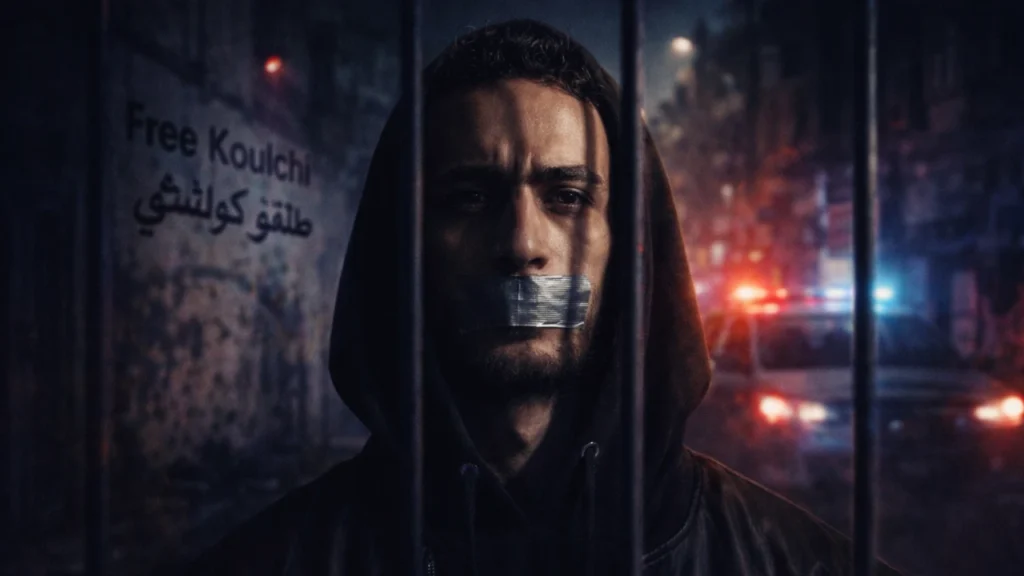
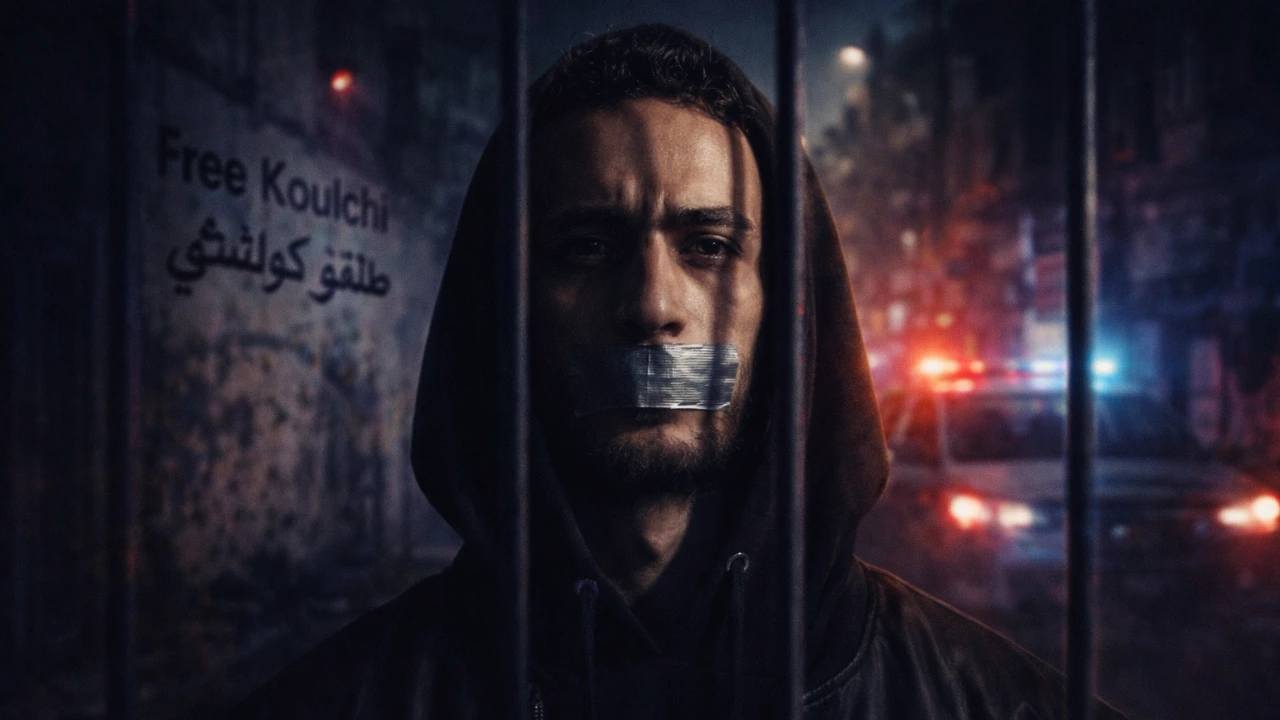
On January 11, 2020, a date chosen to coincide with the anniversary of Morocco’s 1944 Manifesto of Independence, a group of activists launched the “Free Koulchi” (Free Everyone) manifesto. This new document explicitly named Hamza STALiN alongside other figures like journalist Omar Radi, denouncing their arrests as a “serious attack on freedoms” and calling for a Morocco “without political detentions nor prisoners of conscience.”
Human rights groups, including Amnesty International, similarly highlighted the case as part of a broader crackdown where artistic expression is framed as a penal offense rather than protected speech. On appeal in January 2020, his sentence was reduced to eight months, which he served in full. This conviction placed STALiN on the list of “watched” artists, tactics that human rights organizations frame as a deliberate “policy of intimidation” designed to push critical rappers toward self-censorship, exile, or silence.
Throughout the 2020s, he has continued to release unfiltered tracks targeting systemic failures, including “Aphrodite #Free_Koulchi”, where he called for the release of all political detainees and prisoners of conscience. In the song, he addressed his imprisonment rapping: “Thirty-two bars cost me my freedom, I spoke the truth and found myself in a cell. But the flame hasn’t died, the fire is only just beginning” (yalah zandat l 3afiya).
As of early 2026, he continues to navigate the Moroccan music and legal system, symbolizing the “perpetual defendant” status that many Moroccan rappers now occupy. Despite these pressures, STALiN has maintained a defiant presence on social media, using his platform to advocate for the “Free Koulchi” movement and ensuring that the uncomfortable truths of the Moroccan streets continue to find a voice.
VIDEO: STALiN – FHemna (Music Video) | This is the primary song for which STALiN was arrested and prosecuted.
5. Raid: The Protest Rapper Arrested During Gen Z 212 Uprising
Hamza Raid, known simply as Raid (meaning ‘pioneer’ or ‘leader’), has emerged as one of the most prominent faces of Morocco’s new, highly digitalized youth dissent, embodied by the Gen Z 212 movement of 2025. Uniquely among his peers in the Moroccan hip-hop scene, Raid balances his artistic and activist profile with a professional rugby career. Since 2023, he has played for Olympique Casablanca (COC Rugby), having previously featured for WASK Rugby. A Moroccan international, he lines up as a centre three-quarter in rugby XV (15s). A product of Widad El Serghini Rugby Club (WASK), Raid joined the club’s youth ranks in 2007 and spent 16 years there, progressing through every level, including serving as captain.
Raid’s music is almost always political, and that is evident in “Chabab” (Youth), a track released days before the protests began, which quickly became one of the main protest songs of the movement. In it, Raid delivers an indictment of a society that crushes the potential of its young. The song bitterly mocks the very idea of “Youth Day” in a country where growing up means facing difficult choices: “Youth Day in a land where the youth are lined up: you either slip (die/escape), get jailed, or get disabled […] Youth Day without youth,” Raid raps. He then captures the hopelessness of a generation with lines like “The youth want to create, their minds are shining, but the ‘elders’ are ruining everything.” Raid later asks: “Youth Day? Where are the youth?”
Raid’s arrest in late September 2025, during the first intense weekend of the nationwide Gen Z 212 demonstrations, turned him into a powerful symbol of all the innocent young people detained in the protests, particularly within the hip-hop community. The hashtags #FreeRaid and #FreeKoulchi (Free Everybody) spread rapidly online, gaining support from major Moroccan rappers including Don Bigg, ElGrandeToto, Fat Mizzo, Bo9al, and especially Khtek, who became the most vocal advocate and regularly updated the community on Raid’s situation. Other rappers also name-dropped him in protest tracks to show their support, most notably in “GENZ212 – Freestyle Politique” by BR Prod.
He was detained in Casablanca’s Derb Sultan area. He was first questioned and released; then rearrested later that day. Just before the actual arrest, on 30 September, he posted on his Instagram story saying: “Salam Alaykum, just a quick message: I wanted to let you know that there’s a bit of targeting going on today. Two policemen came up to me, asked for my ID, took me to their supervisor, and asked some routine questions, but it was all in the spirit of ‘move along, we know who you are.’”
Prosecutors at the Ain Sebaa Court of First Instance charged him with “participation in an unauthorized non-armed assembly” and “incitement to commit crimes and misdemeanors through electronic means.” Unlike many previous cases against rappers, which often relied on Penal Code articles for “contempt of institutions” or “insults to public officials,” Raid’s charges focused more directly on his physical presence at the protests and his alleged online mobilization.
In a notable shift from the long detentions seen in earlier years, authorities granted him provisional release in early October 2025, a move widely seen as an attempt to ease street tensions amid the decentralized, social media-driven protest wave. In November, a Casablanca court sentenced him to one month in prison with a suspended sentence and a fine of 2,000 dirhams (around $200).
In a podcast after his release, he explained that for him – and for others in similar situations – the real victory is not won in court, but outside it, by “refusing to practice self-censorship” in his music. Still, the personal cost has been heavy. He described how police specifically targeted him as an artist: his phone was confiscated without explanation and never returned. He also revealed that, throughout his career, whenever he or others try to book him for shows, they face repeated obstacles that make it almost impossible; an example, he said, of how the country indirectly silences “certain types of rappers” and discourages others from following the same path.
In the same podcast, he wondered aloud, “Is it time for Kifahi?”, a reference to his most critical and politically charged song, in which he sharply criticizes every level of authority, from top to bottom. He also admitted sadly that he is considering leaving the country because he no longer feels safe as an artist, despite his professional rugby career and family ties in Morocco. He expressed deep gratitude to the team of lawyers who defended him, while noting that most people do not have access to such support in court.
As of early 2026, Raid remains an active and respected voice in Morocco’s conscious hip-hop scene. In a 2021 radio session, he revealed that he holds a master’s degree in social economics and sustainable development. His story carries a grim irony: a man who has proudly represented Morocco on the rugby field now finds himself scrutinized and quietly sidelined at home for giving a rhythmic voice to the struggles of his generation. Like L7a9d before him, Raid has become a powerful reference point in the ongoing tension between artistic expression and the state’s control over the national narrative.
VIDEO: Raid – Chabab (Youth) | This song is suspected to be one of the reasons for which Raid was arrested.
6. Pause Flow: The Rapper Prosecuted Over 10 Different Songs
Jawad Asradi, better known as Pause Flow (often stylized as PAUSE), is a Moroccan rapper and songwriter born and raised in the town of Imouzzer Kandar, in the Sefrou region of the Middle Atlas. He has become one of the most outspoken and skilled political rappers, praised for a style that blends deep philosophical reflections with sharp social and political commentary. His music explores themes of identity, systemic inequality, institutional power, and the daily struggles of Moroccan youth, all delivered mainly in Moroccan Arabic and often incorporating his native Tamazight.
Over nearly a decade, Pause Flow built a strong following through a catalog of introspective and audacious tracks that have amassed millions of streams on YouTube. Songs such as “Ouroboros,” “Sadou,” “Habitus,” and “Mchrdoul” (Ft. Soukaina Fahsi), established him as one of the more intellectually layered voices in the country and a leading figure in the Morap genre, incorporating local sounds with modern rap sensibilities.
His legal troubles reached a peak in November 2025, when authorities arrested him in Sefrou. According to Pause Flow’s longtime collaborator Hatim Bahia, the song “Marionnette” was the main reason for the arrest and subsequent prosecution, followed by the artwork of the track “Pawn Bigg” (song was deleted during the trial). The case was unusual in its scope: prosecutors examined lyrics from more than ten songs spanning roughly eight years of his career. They charged him with “insulting an organized body” (a constitutional institution) and “offending public officials in the exercise of their duties” under Articles 263 and 265 of the Moroccan Penal Code.
Investigators specifically questioned him about lines from tracks such as “Fornax A” (2020), “Doza” (2024), and “Marionnette” (2025), the latter in which he voiced support for the Gen Z 212 protests. In “Marionnette,” Pause Flow unequivocally voiced his support for the protests, rapping: “This is the revolution the people want; let the flame burst if they doubt us. […] Generation Z is paying for what Generation A did.”
Pause Flow was arrested around 18–20 November 2025 and placed in pre-trial detention at the local prison in Sefrou after his first court appearance. The court initially denied unconditional provisional release and later set bail at 100,000 Moroccan dirhams (around $10,000 USD). His family struggled to raise the amount, and he ultimately spent about one month behind bars.
The case triggered one of the largest waves of solidarity ever seen in the Moroccan hip-hop community and beyond. The support was remarkable: even longtime rivals and former adversaries publicly expressed their backing. Lmorphine, with whom Pause has had an on-and-off beef since 2017 and who has never been on good terms with him, wrote: “Today, I am thinking of my fellow writers who are going through a difficult ordeal. May justice be just! #FreePause.”
Don Bigg, despite an ongoing feud that escalated when Bigg released the diss track “Chouka” on August 15, 2025, to which Pause replied later that month with “Pawn Bigg”, still voiced his support. Dollypran, with whom Pause had a beef in December 2023, also showed solidarity, as did Diib, who clashed with Pause in 2018 but later reconciled and even collaborated on the track “Jouj Mizan.”
Other rappers who publicly backed Pause include 7liwa, Lferda, Mehdi Black Wind, and Gnawi, the latter writing “with you, King of Rap.” Bo9al posted a pointed message: “I guarantee you freedom of speech, but not freedom post-speech.” Beyond the hip-hop community, activists and content creators expressed support, including prominent human rights activist Ayoub Habraoui and notable content creator Mustapha Swinga.
Human rights organizations also became involved. The Moroccan Association for Human Rights – Sefrou Branch, through its president Lahcen Assadi, issued an official statement ahead of Pause’s trial on November 27, 2025, at the Court of First Instance in Sefrou. The statement expressed deep concern over the prosecution of the artist for clips from his artistic works, condemned the attack on freedom of expression and creativity in the country, declared absolute solidarity with the artist and his audience’s right to his artistic choices. The Association demanded his release and the dropping of all charges, confirmed its readiness to support the case through all legitimate means, and affirmed that art is a message, not a danger to society.
Political figures also weighed in. Mustafa Lakhsem, the mayor (President of the Municipality) of Imouzzer Kandar, posted a photo with Pause on Instagram with the hashtag #KoulounaPauseFlow (We are all Pause Flow). Fatima Tamni, a member of parliament for the Democratic Left Federation, directed sharp criticism at the Minister of Youth, Culture, and Communication, Mehdi Bensaid, over the arrest of Pause and what she called an “escalating crackdown” on professional journalists. In a written question, Tamni argued that the arrest is not an isolated incident but “a hallmark of a policy of intimidation targeting Generation Z.”
Beyond these official reactions, a petition calling for Pause’s release gathered over 4,600 signatures. Prominent artists such as ElGrandeToto also publicly voiced their support. The widespread mobilization – from former rivals to human rights groups to politicians – made it clear that Pause’s case had become a rallying point for freedom of expression in Morocco.
On 25 or 26 December 2025, the Court of First Instance in Sefrou handed down its verdict: a three-month prison sentence, suspended, along with a fine of 2,000 dirhams (about $200 USD). This allowed Pause Flow to walk free immediately, though the conviction remains on his record.
The episode left a lasting mark. In April 2026, rapper Small X captured the absurdity of the situation in his track “Nagazaki” with the line: “we lived long till we heard rap lyrics read at court”, a reference to cases like those of Pause Flow, Raid, and Youss45, where artists were forced to explain and defend lyrics of their songs in front of judges.
VIDEO: PAUSE – Marionnette (Ft. Musashi) | This is the primary song for which Pause Flow was arrested and prosecuted.
7. L7assal: The Gen Z Rapper Jailed for Anti-Normalization Lyrics
Souhaib Qabli, better known as L7assal (sometimes spelled Al-Hasel, roughly translating to “the trapped one”), has become one of the most visible symbols of Morocco’s intensified 2026 crackdown on youth-driven digital and artistic dissent. A vocational training student from the northern city of Taza, L7assal built a rapidly growing online following through unfiltered protest rap songs. His style is direct and conscience-driven, he blends social and political commentary on domestic issues with passionate pro-Palestine advocacy and an Islamist-inspired moral urgency that sets him apart from many peers.
Politically conscious from the very start of his career, L7assal dedicated his 2023 track “Sidi” (My Master) to the late Abdesslam Yassine, founder of the banned-but-tolerated Islamist movement Al Adl Wal Ihsane (Justice and Spirituality). The video’s opening frame clearly honored Yassine on the tenth anniversary of his death, paying tribute to the non-violent scholar’s uncompromising criticism of the “Makhzen” (Morocco’s deep state) and his bold open letters demanding radical reforms from the monarchy.
This ideological thread runs through much of his catalog: tracks like “Soot” (The Voice) and “Chabiba” (The Youth) tackle corruption and the stifling of free speech at home, while Palestine-focused songs such as “Sorry Maximum” (Sorry Al-Aqsa) and “Ma7kom” (Sentenced) voice regional solidarity.
The song that thrust him into the national spotlight – and ultimately into the courtroom – was “La Litatebi3” (No to the Normalization), uploaded on September 14, 2025. The video opens with a stark declaration of moral duty: “I’m just doing my duty to clear my conscience before God, regarding every pro-normalization follower or tyrant who does not fear the day they meet Allah.” In the first verse, L7assal raps:
“O Lord, grant glory to Islam and Muslims. The ‘normalizer’ has become tyrannical toward us, his hand joined with the hands of criminals. […] He commands what he was commanded to do, driven by the strength of his intense loyalty to the Zionists. […] The stamp of normalization is a stain of shame upon us, and history is recording it; the ships of the occupation are being resupplied in our ports.”
The track resonated with Morocco’s youth, framing the 2020 Abraham Accords as a betrayal of both national principles and the ongoing humanitarian crisis in Gaza caused by Israel. Just months later, on December 26, 2025, he released “La S7a La T3lim” (No Health, No Education) as direct support for the Gen Z 212 protests, with lines that captured the movement’s fury: “Do the people not have the right to be quenched by freedom of expression? Wherever it is released, it is suppressed […] A system corrupt in its entirety, and its roots have already begun to rot […] Release the Gen Z youth, all their demands are clear.”
His final public release before the arrest, “Al Molatame” (The Masked One) on January 28, 2026, was dedicated to Abu Obeida, spokesperson for Gaza’s Al-Qassam Brigades. The opening lines celebrated his heroism: “Before we knew his face, we loved him just for his voice. Before we knew his name, we adored him for his stances… a Gazan in his heroism.”
These themes perfectly overlapped with the Gen Z protests of late 2025, amplifying L7assal’s voice among a frustrated generation. On March 2, 2026, he responded to a police summons in Fes, underwent lengthy interrogation, and was placed in custody before being transferred to Taza. Prosecutors at the Court of First Instance charged him with “insulting public officials in the exercise of their duties,” “insulting an organized body,” and “insulting a constitutional body,” plus an initial count of disseminating false information (later dropped).
His lawyer, Mohamed Taifi, repeatedly highlighted the deliberate vagueness of the charges, noting that the court never specified which exact institution had been insulted, a tactic critics describe as a flexible tool to criminalize any speech touching sensitive domestic or foreign-policy red lines.
On March 27–28, 2026, the court convicted L7assal solely of “insulting a constitutional body” and sentenced him to eight months in prison plus a 1,000-dirham fine (about $100). Dozens of supporters gathered outside the Taza courthouse with banners demanding his release, framing the case as an attack on emerging Gen Z voices who fuse art with activism.
Human rights organizations, including the Moroccan Association for Human Rights (AMDH), condemned the proceedings as arbitrary and politically motivated, especially given L7assal’s affiliation with Al Adl Wal Ihsane. His defense insisted the lyrics and posts were legitimate artistic and political commentary, not targeted insults. As of mid-April 2026, he remains in custody while his legal team prepares an appeal.
L7assal’s rise and swift prosecution underscores the ongoing tension between a youthful, digitally native generation eager to voice socioeconomic and political frustrations and a judiciary increasingly willing to treat rap lyrics and social media content as threats to institutional stability.
VIDEO: L7assal – La Litatebi3 (No to Normalization) | This is the primary song for which L7assal was arrested and prosecuted.
Conclusion: Is Free Speech Crumbling in Morocco?
From L7a9d’s unfiltered protest songs during the 2011–2012 February 20 Movement to L7assal’s sentencing in 2026 for criticizing normalization with Israel and government corruption, Moroccan hip-hop has long served as both a mirror to societal frustrations and a lightning rod for state repression. Over more than a decade, artists such as Mr. Crazy, Gnawi, STALiN, Raid, and Pause Flow have faced arrests, trials, and imprisonment under Penal Code provisions dealing with “contempt of institutions,” “insults to public officials,” and similar offenses.
Their lyrics – often delivered in Darija and tackling police violence, corruption, and the socioeconomic despair of everyday life – have repeatedly been treated not as protected artistic expression under Article 25 of the 2011 Constitution, but as criminal threats to public order and institutional dignity. The cases profiled here reflect an evolution rather than a rupture in the state’s approach: early post-Arab Spring targets like L7a9d set the precedent of framing protest rap as direct institutional insult, while later prosecutions expanded to “street realism” artists such as Mr. Crazy and Gnawi, and then to the digitally amplified Gen Z protests of 2025 with Raid and Pause Flow.
Yet repression has consistently failed to produce silence. Instead, many of these artists have seen their influence persist or even grow. Solidarity campaigns, online mobilization, petitions, and vocal support from established figures have transformed individual prosecutions into broader collective causes. The #FreeKoulchi campaign that gained traction during the 2025 protests embodies a generation increasingly adept at using digital platforms to resist perceived overreach.
In the heat of the Gen Z 212 demonstrations, this defiance found powerful expression through a surge of new protest songs. Most emerged in October 2025, turning frustration into rhythm and amplifying the movement’s demands. Tracks such as Jntyyy’s “Scarecrow,” Kero’s “9ololo,” RBNS’s “Génération Z,” Moro’s “Maghribi Fl Maghrib,” Kartman’s “GenZ212,” Otat’s “N7almo Kbir,” Art-Smoke’s “Karmajiddon” (feat. DJ Sim-H), KDK 44’s “Free Koulchi,” Raffy’s “ACAB,” Dada’s “Maghribi Ka3i,” Pause Flow’s “Marionnette,” L7assal’s “La S7a La Ta3lim,” Solomane’s “Gen Z 212,” and the collective GenZ’s “Freestyle Politique” curated by BR Prod, formed a raw, decentralized soundtrack to the uprising. These songs kept the spirit of resistance alive even as arrests mounted.
The state’s familiar playbook of deterrence may succeed in isolated cases, pushing some artists toward self-censorship or exile. But the broader pattern reveals something deeper: the remarkable resilience of artistic dissent and the growing difficulty of silencing a generation that has learned to rhyme its resistance, navigate the digital world and embrace authority harrasemnt as part of the cost of being true to their craft.
At the end, one must remember that the machinery of oppression spares no one, the long arm of cruelty eventually reaches everyone. As Raid warned during Gen Z protests in a message reported by Barlaman Today: “A message to everyone, especially those who think this doesn’t concern them: you’re not as far from it as you think. It’s just not your time yet. One day, it will land at your doorstep, and even if you’ve been selfish, you’ll find us right behind you.”
Written by:
Ben Tarki Moujahid
Author
 View all posts
A music critic and a researcher, Moujahid writes in-depth articles analyzing Moroccan and global hip-hop, blending insights from industry experts into compelling, well-rounded critiques. Beyond writing, he plays a pivotal role in shaping the magazine's editorial vision, refining its tone, structure, and style to elevate the reader's experience. As the lead editor, Moujahid meticulously oversees and polishes nearly all published articles, ensuring the magazine maintains its reputation as a trusted and influential voice in music journalism.