Koora: The Deep Influence of Football on Moroccan Rap
This collection is a collaboration between our Instagram community, who provided the nominations, and our editorial team, ultimately spotlighting the most compelling football references in Moroccan rap.
On 19 October 2025, under the floodlights of Santiago’s Estadio Nacional Julio Martínez Prádanos, the sounds were unmistakably Moroccan. Flags rippled red and green. Drums pounded from the stands. When Yassir Zabiri’s second goal struck the back of Argentina’s net, sealing Morocco’s 2–0 victory in the 2025 FIFA U20 World Cup final, the noise felt like a national heartbeat echoing halfway across the world. Within minutes, Rabat’s main boulevards filled with horns, chants, and fireworks. “We don’t fear any team,” Zabiri said post-game. “They talked too much, and once the match started, we devoured them.”
For Morocco, this was the first-ever youth world title, a powerful validation of a century-long relationship between football and national identity. To understand how a country of 37 million became one of world football’s most dynamic forces, one must trace the game’s deep roots, from the streets and ports of colonial Morocco where it first took root, spread by soldiers and merchants during the French and Spanish protectorates (1912–1956), to the modern academies.
Clubs like Wydad Athletic Club (1937) and Raja Club Athletic were born as spaces of resistance, asserting collective identity under foreign rule. From the pioneering career of Larbi Ben M’barek (widely considered the first African football star) to the seismic victory of the 1976 African Cup of Nations and the historic 1986 World Cup run, football has been an instrument for expressing a modern, postcolonial Moroccan identity. The success of the “Golden Generations” was followed by crucial infrastructure reform, culminating in the Mohammed VI Football Academy (2009) and the unparalleled, history-rewriting run to the 2022 World Cup semi-finals.
The sport is a cultural language, bridging Morocco’s Arab, Amazigh, and African dimensions. It’s a source of transnational pride and a cornerstone of soft power, linking the kingdom to the diaspora and the world stage.
But what happens when this century of passion, struggle, and ambition is captured by the kingdom’s sharpest, most modern cultural force? Moroccan rap has become the megaphone and the archive for this national obsession. The following is a look into the lyrics, stage names, and projects where the pitch and the mic become one, revealing how the beautiful game continues to define the Moroccan soundscape.
WATCH: Stormy & ElGrandeToto – MARADONA REMIX (Official Music Video) | The remix released August 17, 2024, builds on the massive success of Stormy’s original hit from February 10, 2024.
Rap Albums/EPs Largely Inspired by Football
Football’s presence in Moroccan rap is cemented through projects named after major players, venues, or concepts from the game, showcasing a deep, conscious connection to the sport.
“Bebebtoo” (EP) by Obito333
The Ratab-native rapper released this EP in May 2025, naming it after Brazilian football legend Bebeto (born 1964). The project is steeped in football imagery: the first line is “Like Rodrigo, we flip the game,” and it includes tracks titled “Antony” (likely for the Brazilian winger, born 2000) and “Tawssi.” The latter is a reference to Moroccan coach Rachid Taoussi (born 1959).
The lyric “I feel like Madrid and managed by Taoussi” uses irony to boast. While on the surface it names a respected coach, the implication is that his own skill is so supreme that it would overwhelm a manager of that caliber, much like a top-tier club would.
VIDEO: OBITO333 & VILLAIN – FAMA HAJA (Official Music Video) | Serving as the lead track for his Bebetoo EP, the video features Obito333 prominently displaying Brazilian footballer Bebeto’s Deportivo La Coruña #11 jersey.
Rap Songs Named After Football Players and Concepts
“Maradona” by Stormy (feat. ElGrandeToto)
- A massive hit from Rabat-native Stormy, later remixed with Casablanca rap star ElGrandeToto, with both versions amassing over 100 million streams. The song’s most famous lyric, from the hook, is: “Come to the hood and see how many wasted Messi and Mbappe.” This poignant line speaks to the abundance of raw football talent in Moroccan neighborhoods that, due to a lack of opportunity, never makes it to the world stage.
“Messi” by Bo9al
- Released on September 19, 2024 (2M+ views). The title is a direct metaphor for self-made success. In the hook, Bo9al declares, “we grinded solo like Messi,” comparing his independent hustle to Lionel Messi’s legendary individual skill and journey.
“Bassir” by Lmehdi
- Released on December 30, 2022, this track pays homage to Moroccan football hero Salaheddine Bassir (born 1972). It opens with a clever double-entendre: “14 shinning, 14 on Jersey like Bassir.” “14” simultaneously refers to: Moroccan slang for a knife (with a 14 cm blade), and the specific jersey number worn by striker Salaheddine Bassir.
“Higuita” by Mehdi Black Wind
- Released on December 18, 2020, this song features the Colombian goalkeeper René Higuita on its art cover. The key line, “Not Zniti, I am Higuita,” is a bold statement. While the reason is ambiguous, it suggests the artist identifies more with Higuita’s flamboyant and unconventional “scorpion kick” style than with the more traditional prowess of Moroccan goalkeeper Anass Zniti.
“San Siro” by Lferda
- Released on April 27, 2024 (19M+ views), this track is named after the iconic stadium in Milan, Italy. Lferda uses it as a metaphor for his demanding environment: “On the scene, everyone’s moving like they’re in San Siro. Now tell me, who’s brave enough to come into the ghetto?” He compares the rap scene to the intense pressure of a packed stadium, questioning who has the courage to enter his world.
“Wagandi” by Lquinze
- Released on May 28, 2023, the title references a common slogan from the ultras (hardcore fans) of CODM, the football club of Meknes. “Wagandi” roughly translates to “don’t give up” or “keep going,” capturing a spirit of perseverance. The artist also released “Schillaci” as the first single for his EP ‘Beatophile Vol.3,’ named after Italian footballer Salvatore Schillaci.
“Ballon d’Or” by Saad Dsouli x Breezy
- The final track on Breezy’s album “Papa,” released on May 28, 2022. The title references football’s most prestigious individual award. The hook is built around Breezy repetitively claiming the prize for himself: “we are Ballon d’Or,” asserting his and his crew’s top-tier status.
“Cold Palmer” by Mirv
- Released on April 6, 2025, this song is a deep-cut homage to football culture. The music video is filled with imagery: it opens with a ball on the ground and a sofa draped with over 10 jerseys (from Barcelona to Manchester United), shows medals won by the protagonist, and features pictures of legends like Messi and Ronaldo on the walls. The title itself is a pun on English footballer Cole Palmer, with the lyric “My heart is cold like Cole Palmer,” playing on the player’s name to convey a sense of coolness and emotional detachment.
VIDEO: Bo9al – Messi (Official Music Video) | The notoriously energetic and raw rapper delivers a high-voltage song as usual, produced by Dino and released September 19, 2024.
Moroccan Stage Names Inspired by Football Legends
The influence of koora (football) extends beyond the pitch and into the very identities of Moroccan rappers. Several artists have adopted stage names or aliases that pay homage to global football icons, though the inspiration behind some remains a subject of debate within the fan community.
Yasiin, aka Figoshin (from Ifran): The name is a fusion of two football legends. His real name is Yassin, with “shin” likely taken from the iconic Soviet goalkeeper Lev Yashin, and “Figo” from Portuguese winger Luis Figo.
Anass, aka Guzman (from Rabat): The origin of his alias is a popular topic of debate. It is believed to be a nod to one of the footballers named Guzman, though some fans speculate it references the drug lord “El Chapo.” He hasn’t explicitly confirmed either, but his football fandom is clear in tracks like “Hakimi” and “Sofyan Boufal.”
Mohamed, aka Shinji (from Meknes): His stage name is widely thought to be a tribute to Japanese attacking midfielder Shinji Kagawa.
Samir, aka Samaras (from Sidi Kacem): The artist has directly confirmed that he took his name from Greek former professional striker Georgios Samaras.
VIDEO: LMEHDI – IMPACT (Official Music Video) | Released November 9, 2024. True to his signature style, Lmehdi, one of the rappers who consistently weaves football into his lyrics, again references Bassir’s iconic number 14 and proudly showcases symbols of his hometown club, CODM of Meknes.
The World Cup Effect: Qatar 2022's Lasting Impact on Moroccan Rap
The Moroccan national team’s historic run to the semi-finals of the 2022 FIFA World Cup in Qatar sparked a surge of football references, immediately integrating the heroes of that tournament into the rap lexicon. Star players Achraf Hakimi and Yassine “Bono” Bounou became symbols of national pride and clutch performance.
Lyrical Tributes to National Heroes
Rapper Damost captured Bono’s iconic penalty-saving focus with the line, “Under pressure, I grin like Bono,” a direct reference to the goalkeeper’s intense, teeth-baring grimace that became a symbol of resilience.
Stormy in Maradona used Hakimi’s success to speak on aspiration: “Nothing will ever be expensive for you, you just need Hakimi’s salary in Paris.”
The collaborative track ‘Nichan’ by Lferda and 7-Toun (released July 10, 2022) features the boast, “We are here to run things, Lferda and 7-Toun like Ziyech and Hakimi,” comparing their partnership to the famed duo on the field.
The “Hakimi” Double Meaning
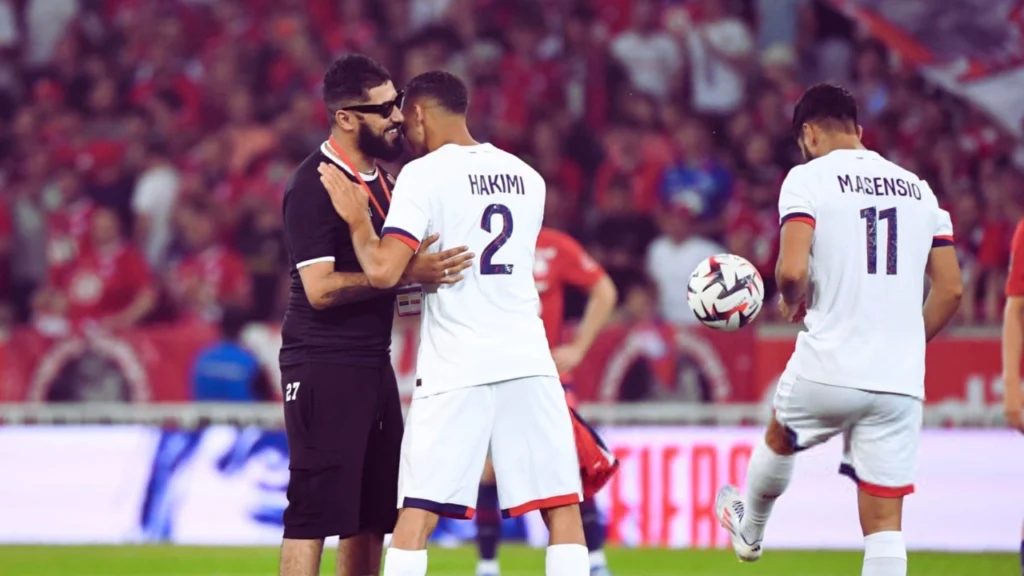
The player’s influence even entered local slang. In his May 2024 track “Hakimi,” rapper 2TAF uses the name as street slang for pills. This derives from Hakimi’s jersey number, 2, with these specific pills being commonly known as “2 points” or “deux points” in Morocco, a reference to the benzodiazepine pill Rivotril (Clonazepam), which is often illicitly used as a sedative. This is a distinct usage from the celebratory references to the player himself.
A Wave of Tributes
This national pride sparked a series of tracks directly named after the team’s heroes, including:
“Ziyech” by LeS777 (Feb 2022)
“Ziyech” by Kouz1 (Jun 2024)
“H Ziyech” by 3robi x S3kro (Nov 2024)
“Hakimi” by Bouzi (Aug 2025)
VIDEO: French Montana – MOROCCO [Official Video] | Released December 15, 2022, this track is a pure celebration of the national team’s historic World Cup run. The video intercuts iconic moments from the pitch like Hakimi and Boufal’s emotional celebrations with their mothers and Bono’s pivotal penalty save, with powerful scenes of Montana leading a massive crowd of fans in Times Square.
The World Cup Effect: A Magazine Born of an Iconic Moment
The unifying chant “Dima Maghrib” (Morocco Forever) that echoed throughout the World Cup directly inspired our magazine’s identity. It is from that powerful, unwavering national spirit that DimaTOP was born, with our slogan “DimaTOP, Dima Maghrib,” dedicating us to the dynamism of Moroccan hip-hop.
That historic run made us love our nation in a new way. It was a reminder that pride in our country’s excellence is separate from our critiques of its governance. We realized that despite disagreements or concerns, we must never overlook the incredible talent our nation produces.
This is the core mission of DimaTOP: to highlight and showcase that Moroccan excellence, what we call MoExcellence.
Football as the Core of Entire Rap Songs
The connection between rap and football in Morocco is often celebratory and direct, with many tracks created solely as tributes to the sport and its biggest moments.
- “Koora F’Dem” by Casa Crew (2009, and potentially earlier)
A foundational track that uses football as its core aesthetic. It opens with a referee’s whistle and weaves the sound throughout its melody. The lyrics are a direct tribute to Morocco’s football culture, name-dropping players like Boudarbala and iconic moments like Mustapha Hadji’s bicycle kick. The hook encapsulates this passion, declaring: “We have football in blood like plasma, stadiums always full, packed with people.” - “Moul Ballon” by Dizzy DROS (June 17, 2018)
Also known as “L’Kora 7na Maliha” (Soccer, we’re the ones who own it), this track is a definitive football anthem. The title translates to “Owner of the Ball,” positioning DROS as a master of his craft, much like a skilled footballer. The music video is a vibrant display of street football culture, featuring ball jugglers and passionate fans. Its status was cemented when DROS performed it at the FIFA Club World Cup™ opening ceremony on February 1, 2023. His football-themed discography also includes “BENTLBLAD” (feat. Nayra) and his contribution to the “Welcome to Morocco” official song for the 2022 FIFA Club World Cup. - “Sir Sir” by Negaphone (Released December 12, 2022)
This song was created specifically to celebrate the Moroccan national team’s historic 4th-place finish in the Qatar World Cup. The music video captures the euphoric street celebrations. The track is a tapestry of World Cup pride, sampling emotional commentator reactions and using the ubiquitous stadium chant “Sir Sir” (meaning “Go! Go!”) in its hook: “You got a headache hearing the whole stadium [shouting] ‘Sir Sir Sir Sir.’” - “Hakimi” by Guzman and L’Inconnu (Released December 8, 2022)
A dedicated World Cup anthem released during the tournament’s peak. It features a sample of a commentator praising Achraf Hakimi for his decisive penalty against Spain. The lyrics capture the team’s confident, underdog spirit with lines like: “Like Mexico like Qatar .. win or lose, we stay calm … we don’t have Neymar but we have Boufal.”
This category also includes French Montana’s “Morocco”, and these tracks represent just a sample of the many rap songs created exclusively as soundtracks for the beautiful game.
VIDEO: Dizzy DROS – Moul Ballon (Official Music Video) | Released June 17, 2018, amassing over 30 million views. Its legacy was secured with a landmark performance by DROS at the 2023 FIFA Club World Cup™ opening ceremony.
Moroccan Rappers Known for Heavy Football References
A handful of rappers have made football culture a central pillar of their lyrical identity, weaving players, teams, and the sport’s slang into the very fabric of their music.
- L’Morphine
For L’Morphine, cinema and football form the core of his metaphorical world. A prime example is his track “La Masia” (feat. Jntyyy, June 5, 2025), where he declares, “We are a product of La Masia’s discipline,” using FC Barcelona’s famed youth academy as a metaphor for his own superior craft. - Fat Mizzo
His lyrics are dominated by references to basketball, MMA, and football. His August 2025 track “VFC” (a football reference) features stadium artwork and is packed with clever allusions: On wealth and taxes: “The accountant told me, ‘Keep it down; don’t be a smartass. Not even Ronaldinho could dribble taxes.'” This brags about his financial success while humorously nodding to the Brazilian star’s real-life tax evasion case.
On social scenes: “Why would I go to a party that has more freekicks than the highlights of Juninho?” Here, “freekicks” is Moroccan slang for unattractive women, contrasted with Juninho Pernambucano, a legendary free-kick specialist.
His references are global, name-dropping players like Neymar, Kylian Mbappé, Sofyan Amrabat, Son Heung-min, and Denílson, and even using a mock football commentator as a skit in his songs. - Deimi
Deimi’s lyrical universe is built on drugs, anime, and football. His track “Captain Majid” (May 20, 2025), the Arabic name for the anime Captain Tsubasa, features the line, “You can’t catch it if I kick it, like Captain Majid.” This implies his complex wordplay and metaphors are as unstoppable as a powerful kick from the anime hero, flexing as one of Morocco’s best word-benders. - Diib
Philosophical musings, social criticism, and football references define Diib’s work. His 2019 song “Gattuso” uses the notoriously tenacious Italian midfielder Gennaro Gattuso as its artwork and central theme. In “Makareb” (feat. Kira7, Feb 2024), he delivers a deeply poetic line: “I was born the year Baggio died standing in the stadium,” referencing the iconic, despairing image of Italian star Roberto Baggio after his missed penalty in the 1994 World Cup final. - LMLTM
Street life, football, and the culture of ultras dominate his lyrics. With an ultra-like fanbase, he frequently uses terms like tifos (large displays) and echaps (scarves). His song “Ultrap” (Aug 2023) directly references this identity, connecting his fan base to street credibility and territorial dominance. - Stormy
Beyond his hit “Maradona,” Stormy frequently uses sports for motivation. A key line from that song, “I did it with my hand, my hand like Diego Maradona,” proudly compares his controversial success to the Argentine legend’s infamous “Hand of God” goal.

Regional and Subcultural Connections between Rap and Football
The football-rap link also manifests through regional pride and specific subgenres.
The Meknes Scene: A cohort of Meknes-native rappers, including Bludinero, Camarad, Libre Man, and Lquinze, are known for their football-focused lyrics and are often visible supporters of their local club, CODM, in the stadium stands.
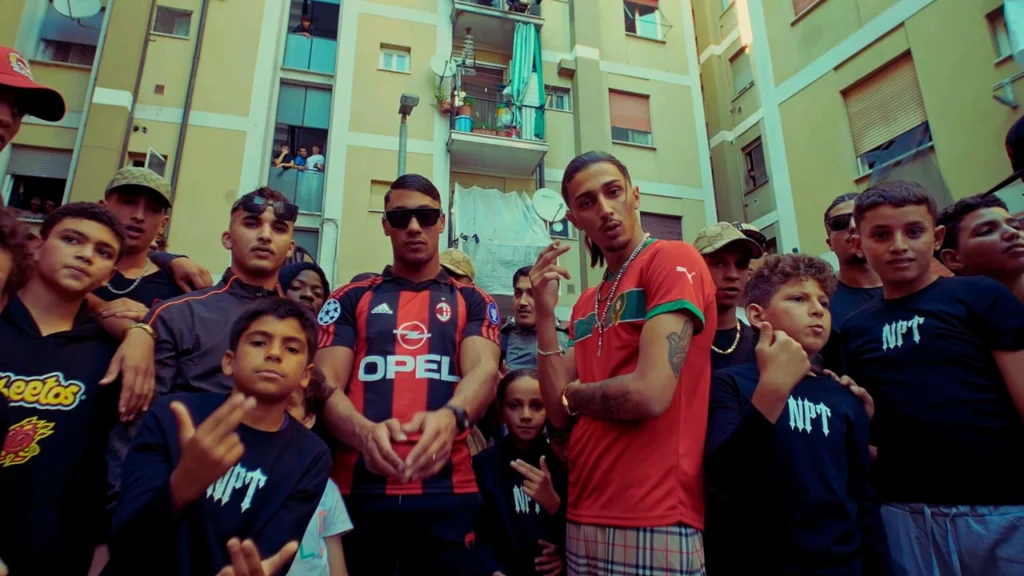
Rap Zan9awi (Moroccan Gangsta Rap): This gritty subgenre, focused on street life and crime, often adopts football attire as a key part of its aesthetic. Rappers and their circles are frequently seen wearing jerseys of European clubs like Read Madrid, AC Milan, and PSG, the typical clothing of the “mcharmline” (‘hood guys’), mirroring a global trend where street culture and sportswear intersect.
Club Allegiances: Many rappers openly support specific clubs, such as ElGrandeToto and Dizzy DROS for Wydad AC, 7liwa for Raja CA, Lquinze for CODM, and Vira for MAS, further solidifying the bond between musical and footballing tribes.
VIDEO: MR CRAZY – 3a9liya Mhabsa [OFFICIEL CLIP] | An iconic and controversial video in the Rap Zan9awi (Moroccan gangsta rap) scene. Its notoriety was such that it contributed to the 17-year-old rapper’s imprisonment on charges of promoting drugs and fabricating a national anthem. The video is a textbook display of the ‘mcharmline’ aesthetic, featuring classic markers like the golden watch and an array of football jerseys.
Diaspora Rappers and Football: Wearing the Nation with Pride
For many Moroccan diaspora rappers, football and the national team jersey serve as powerful, visible symbols of identity, connecting them to their heritage from abroad. This is often reflected in their music videos, cover art, and public appearances.
In Europe:
Moroccan-Spanish rapper Morad has a well-documented friendship with Achraf Hakimi, which extends into his music. He released the track “Paris Como Hakimi” (January 12, 2024), a direct tribute to the player. Morad also has a song titled “Lamine”, after Barcelona prodigy Lamine Yamal, which opens with a hybrid intro of Spanish and Arabic commentators reacting to one of Yamal’s goals.
Moroccan-Italian rapper Baby Gang frequently incorporates national pride into his visuals, notably wearing the Moroccan jersey in music videos like “Macro Mafia” and using it for the cover art of his song “Fratello Mio”.
Moroccan-Dutch rapper Ashafar is often seen sporting the national team jersey, including on the cover for his track “Banderas” (wearing Ziyech’s #7) and in the visuals for “M.D.L.R” (feat. Benzz).
In the UK:
Moroccan-English rapper Benzz has made the Moroccan national team jersey a core part of his public image, wearing it consistently across his music videos and public appearances as a badge of pride.
In North America:
Moroccan-American rapper Yasin consistently represents his heritage by wearing the Moroccan national team jersey, from his collaborative track “Maroc Boy” with Ermaine to his “Radar Freestyle.” This aesthetic is shared by his entire collective, ‘Maroc Boyss’, who frequently don the jersey in their visuals.
This widespread use of football symbolism underscores how the national team’s success provides a unifying and proud identity for Moroccans across the globe.
Professional Collaborations: Music, Football, and Brand Power
The synergy between Moroccan rap and football has moved beyond lyrics into high-profile professional partnerships, showcasing the cultural power of both scenes.
Dizzy DROS, Spotify Morocco & The National Team
In a landmark partnership between Spotify Morocco and the Equipe du Maroc (Morocco National Football Team), rapper Dizzy DROS sat down with the squad for a discussion on music tastes. This collaboration highlighted a well-known fact within Moroccan culture: the players are avid listeners of the local rap scene, just as the rappers are dedicated fans of the players, creating a mutual admiration society.
Stormy, Achraf Hakimi & INWI: A Hit Becomes a Jingle
Stormy’s summer hit “Popo” was officially adopted by the major telecommunications company Inwi for a nationwide campaign. The partnership included a specially branded version of the track and a high-profile cameo appearance by global football star Achraf Hakimi, merging musical catchiness with athletic star power.
Dizzy DROS & The FIFA Club World Cup
Dizzy DROS was selected as the sole rapper to feature on “Welcome to Morocco”, the Official Song of the FIFA Club World Cup 2022. The song, produced by superstar hitmaker RedOne, also featured a roster of acclaimed Moroccan artists including Aminux, Asma Lmnawar, Douzi, Hatim, Nouamane, Rym, and Zouhair, placing DROS and Moroccan music on a global stage.
VIDEO: STORMY – Khalik Dima Top (Inwi Campaign) | Released on December 27, 2024, this major ad campaign was launched following the massive success of “Popo”, (Feb 1, 2024). That Brazilian-funk hit, filmed in Rio de Janeiro, became one of the most consumed songs in Moroccan rap history, amassing over 55 million YouTube views and 40 million streams. This follow-up campaign itself garnered over 7 million views.
Football in Moroccan Rap Beefs
The strategic use of football imagery has even found its way into the heart of rap rivalries, as exemplified by one of Morocco’s most notable beefs: Nessyou vs. Moro.
In this high-stakes exchange, Nessyou fired a cleverly targeted shot with his diss track “Tony,” released on February 13, 2018. The track was named after French football referee Tony Chapron (born 1972), whose picture was used as the artwork. This was a deliberate insult aimed at Moro, who cultivated a godfather-like, authoritative persona. By comparing him to Chapron, Nessyou implied that despite this facade, Moro was fundamentally error-prone and incompetent, failing to live up to the powerful image he projected.
Moro’s retaliation the very next day (February 14, 2018) was equally cunning. He released his own diss track, also titled “Tony.” However, in a brilliant rhetorical counter, his artwork featured Tony Montana, the iconic gangster from the film Scarface. This move rejected Nessyou’s football referee analogy and reasserted Moro’s desired identity as a formidable and ruthless kingpin, not a bumbling official.

Conclusion: A Nation's Story, Told Through Sport and Song
Morocco’s 2025 U20 World Cup victory is more than a trophy; it is a triumphant punctuation mark in a century-long story of persistence and reinvention. From the colonial playgrounds of Casablanca to the modern academies of Salé, from the historic chants of 1986 to the global roars of 2022 and 2025, Moroccan football has consistently traced the nation’s modern evolution—from resistance to reform, from local obsession to global power.
Today, Morocco stands not just as a footballing nation, but as a case study in how sport can articulate identity and ambition. The deep-seated culture of koora, with its complex slang, regional loyalties, and international aspirations, provides Moroccan rappers with an inexhaustible vocabulary for metaphor, wordplay, and social commentary. Whether through the global confidence of a bar like, “We don’t have Neymar but we have Boufal,” or the poignant social observation of “Come to the hood and see how many wasted Messi and Mbappe,” these lyrics capture the nation’s layered reality.
The threads of the sport, the discipline of La Masia, the intensity of Gattuso, the self-made triumph of Messi, and the controversial brilliance of Maradona, are woven directly into the fabric of the country’s most vital contemporary art form. The next generation of artists, who watched Zabiri lift the U20 trophy, inherit more than a blueprint; they inherit a limitless source of lyrical ambition and a renewed sense of HOPE.
This symbiotic relationship finds a compelling parallel in American hip-hop’s deep connection to basketball. While both genres draw from their local environments, the cultural ‘flex’ in Morocco is distinct. It’s not just about courtside status; it’s about the authentic loyalty shown in the stadium stands, a testament to a national identity forged on the pitch. This shared passion is the bedrock of these lyrical tributes. For our readers who enjoyed this exploration, watch for our upcoming deep dive into the equally rich bond between American rap and basketball.
Finally, we extend our deepest gratitude to everyone who contributed to this article by responding to our questionnaire. Your insights were invaluable in capturing the true depth of this cultural phenomenon.
Written by:
Ben Tarki Moujahid
Author
 View all posts
A music critic and a researcher, Moujahid writes in-depth articles analyzing Moroccan and global hip-hop, blending insights from industry experts into compelling, well-rounded critiques. Beyond writing, he plays a pivotal role in shaping the magazine's editorial vision, refining its tone, structure, and style to elevate the reader's experience. As the lead editor, Moujahid meticulously oversees and polishes nearly all published articles, ensuring the magazine maintains its reputation as a trusted and influential voice in music journalism.